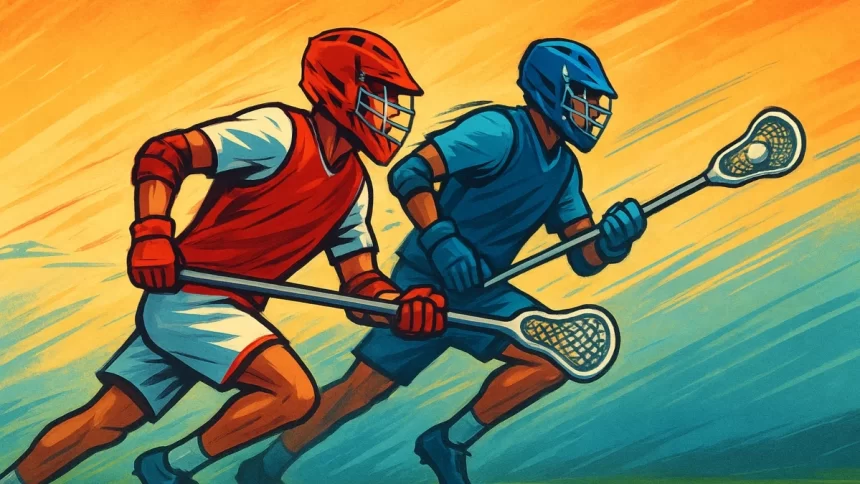
Lacrosse is no longer just North America’s oldest team sport—it’s a global movement powered by agility, strategy, and a return to prestige as lacrosse returns to the Olympics in 2028. With roots tracing back to Indigenous peoples and a modern flair amplified by collegiate and professional leagues, lacrosse offers a thrilling blend of tradition and innovation.
A Glimpse Into Lacrosse’s Legacy
- Origins: First played by Native American tribes as a spiritual and community event.
- Evolution: Adopted in the 19th century by schools and clubs, leading to today’s organized structure.
- Olympic Comeback: After over a century, lacrosse returns to the Olympics in Los Angeles 2028—featuring a faster, globally accessible format known as Sixes.
Core Lacrosse Rules: Simplified for Players and Fans
Game Structure
- Men’s Field Lacrosse: 10 players per team.
- Women’s Field Lacrosse: 12 players per team.
- Lacrosse Sixes (Olympic Format): 6 players per side, blending speed with skill.
Objective
Score by shooting a hard rubber ball into the opposing team’s net using a lacrosse stick. Each goal adds one point, and the team with the highest score after regulation wins.
Game Mechanics in Detail
1. Starting Strong: The Face-Off
- Used to begin play and resume after goals (in men’s lacrosse).
- Two players crouch at midfield, battling for possession using their sticks and quick reflexes.
2. Movement and Possession
- Cradling: A rocking motion with the stick to keep the ball secure while running.
- Passing: Accurate stick handling is key for seamless transitions.
- Shooting: Precision and power—aiming for the net past defenders and the goalie.
3. Scoring Rules
- The ball must fully cross the goal line.
- Crease Rules: Offensive players can’t enter the goal crease unless shooting or following through; violations result in turnovers.
Fouls and Penalties
Understanding Lacrosse Rules means recognizing what’s not allowed:
- Personal Fouls:
-
-
- Slashing, cross-checking, tripping.
- Result in 1-3 minute penalties where the offending player leaves the field.
-
- Technical Fouls:
-
-
- Offside, holding, illegal screens.
- Usually result in possession changes rather than time penalties.
-
- Women’s Lacrosse Specifics:
-
- Stick checking must be controlled and non-aggressive.
- Penalties often lead to free positions or defenders backing away.
⚔️ Men’s vs. Women’s Lacrosse: How the Rules Compare
| Feature | Men’s Lacrosse | Women’s Lacrosse |
| Contact Level | Full-body checks allowed | Minimal, mostly stick-based |
| Protective Gear | Helmet, gloves, shoulder pads | Eye goggles, mouthguard only |
| Playing Style | Aggressive, fast-paced | Tactical, spatially aware |
| Field Dimensions | ~110 x 60 yards | Slightly larger |
| Rule Complexity | Extensive penalties | Emphasis on movement rules |
⏱ Timing and Substitutions
- Men’s Lacrosse: Four quarters, 15 minutes each.
- Women’s Lacrosse: Two halves of 30 minutes.
- Lacrosse Sixes (Olympics): Four 8-minute quarters, rapid transitions, constant movement.
- Substitutions: “On the fly”—players can enter and exit without stopping play, keeping the pace high.
Offside and Field Positioning
- Offside Rule: Teams must maintain a balance across the midfield line—at least 3 defenders and 4 attackers must remain on their respective sides.
- Violation: Leads to a technical foul and a turnover.
Strategy Tips for Mastering Lacrosse Rules
- Stay in Motion: Lacrosse punishes stillness—off-ball movement is key.
- Communicate Constantly: Calls like “man-on” or “slide” keep defense coordinated.
- Master the Ground Ball: Winning loose balls often dictates momentum.
- Anticipate Play: Successful players read the field several moves ahead.
- Respect the Rules: As lacrosse returns to the Olympics, rule variations will arise—especially with Sixes.
Why Lacrosse’s Olympic Return Matters
- Global Expansion: Lacrosse is now played in over 70 countries.
- Sixes Format: Faster, more inclusive, and TV-friendly—perfect for Olympic audiences.
- Increased Visibility: Young athletes, clubs, and creators can leverage this moment to educate and inspire.
Conclusion
As lacrosse returns to the Olympics, understanding lacrosse rules empowers not only players but creators, coaches, and fans. This sport is more than just action—it’s storytelling in motion, shaped by centuries of cultural significance and renewed global excitement.
ALSO READ: R Ashwin Announces IPL Retirement, Eyes Global T20 Leagues