

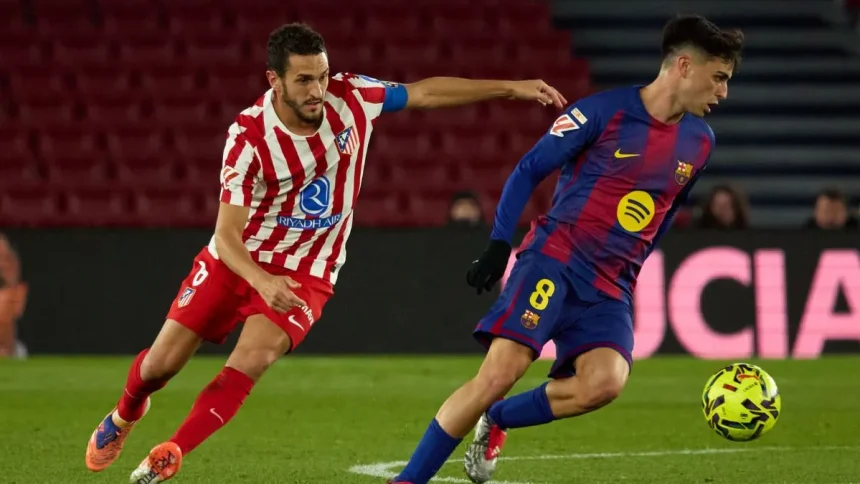
From the first whistle, it was clear that this was not going to be a patient, probing contest. Atlético Madrid’s High-Press arrived like a wave, aggressive, coordinated, and relentless. Barcelona’s usual comfort in building from the back vanished within minutes, replaced by rushed passes, broken structures, and uncharacteristic defensive errors. This was a tactical masterclass built on timing, intensity, and collective intelligence, and it exposed every crack in Barcelona’s defensive organization.
- How Atlético Madrid’s High-Press Set the Tone Early?
- Midfield Traps That Amplified Atlético Madrid’s High-Press
- Barcelona’s Defensive Line Under Constant Stress
- Wide Overloads Created by Atlético Madrid’s High-Press
- Transition Play That Punished Every Mistake
- Simeone’s Tactical Evolution Behind Atlético Madrid’s High-Press
- Why Barcelona Could Not Adjust to Atlético Madrid’s High-Press?
How Atlético Madrid’s High-Press Set the Tone Early?
The foundation of the performance was Atlético Madrid’s High-Press in the opening phases. Diego Simeone instructed his forwards to lock onto Barcelona’s center backs, cutting off central passing lanes while forcing the ball wide. The press was not reckless. It was triggered by specific cues, particularly when Barcelona attempted short build-up sequences from goal kicks.
The compact front line ensured Barcelona’s defenders had little time on the ball. Every backward touch invited pressure, and every sideways pass narrowed the options. This suffocating approach meant Barcelona could not establish rhythm, and their defensive line was repeatedly dragged into uncomfortable positions.
Midfield Traps That Amplified Atlético Madrid’s High-Press
What made Atlético Madrid’s High-Press devastating was the role of the midfield. Atlético’s central midfielders stepped high to block progressive passes into Barcelona’s pivot. This created pressing traps in central zones, forcing turnovers in dangerous areas.
Barcelona’s midfield struggled to offer passing angles, leaving defenders isolated. When the ball entered midfield, Atlético collapsed aggressively, winning duels and immediately transitioning forward. The distance between Atlético’s lines remained compact, ensuring there was no escape route once the press was activated.
Read More


Barcelona’s Defensive Line Under Constant Stress
Barcelona’s defensive structure depends heavily on composure and spacing. Against Atlético Madrid’s High-Press, both disappeared. The back line was forced to defend facing its own goal far too often. High turnovers meant Atlético attacked a retreating defence, which is always a recipe for chaos.
Full backs were pinned back, centre backs were dragged wide, and the defensive line lost its shape. Atlético exploited these moments with direct vertical passes, stretching Barcelona horizontally and vertically in the same sequence. The press was not just about winning the ball but about where the ball was won.
Wide Overloads Created by Atlético Madrid’s High-Press
Another crucial aspect of Atlético Madrid’s High-Press was how it manipulated wide areas. By forcing Barcelona to build through the flanks, Atlético created numerical superiority near the touchline. Wingers pressed from the outside, full backs stepped up, and midfielders covered the inside channels.

This funneling effect trapped Barcelona near the sideline, where passing options were limited. Once possession was regained, Atlético immediately attacked the half-spaces, pulling Barcelona’s defenders out of position and opening lanes for runners arriving late into the box.
Transition Play That Punished Every Mistake
The real damage came after the ball was won. Atlético Madrid’s High-Press seamlessly transitioned into fast attacking sequences. Instead of slowing the tempo, Atlético played forward instantly, targeting the space behind Barcelona’s advanced defensive line.
Barcelona’s defenders were often caught between stepping up and dropping back, a hesitation Atlético exploited ruthlessly. The speed of transition meant Barcelona had no time to reset their defensive shape, leading to repeated high-quality chances.
Simeone’s Tactical Evolution Behind Atlético Madrid’s High-Press
This version of Atlético Madrid’s High-Press reflects Simeone’s evolution as a coach. While Atlético are known for defensive solidity, this approach blended aggression with structure. The press was synchronized across all lines, with forwards, midfielders, and defenders moving as a unit.
Rather than sitting deep, Atlético controlled the match territorially. By pressing high, they dictated where Barcelona could play and how often they could breathe on the ball. It was proactive football rooted in discipline rather than risk.
Why Barcelona Could Not Adjust to Atlético Madrid’s High-Press?
Barcelona attempted to bypass Atlético Madrid’s High-Press with longer passes, but this only fed Atlético’s defensive strength. Without consistent runners in behind or quick switches of play, Barcelona became predictable.
Read More

The lack of adaptability meant Atlético continued to press with confidence. Every successful turnover reinforced the belief in the system, while Barcelona’s frustration grew with each failed build-up attempt.
Also Read: Arsenal vs City: Can One Team Win Every Trophy This Season?