


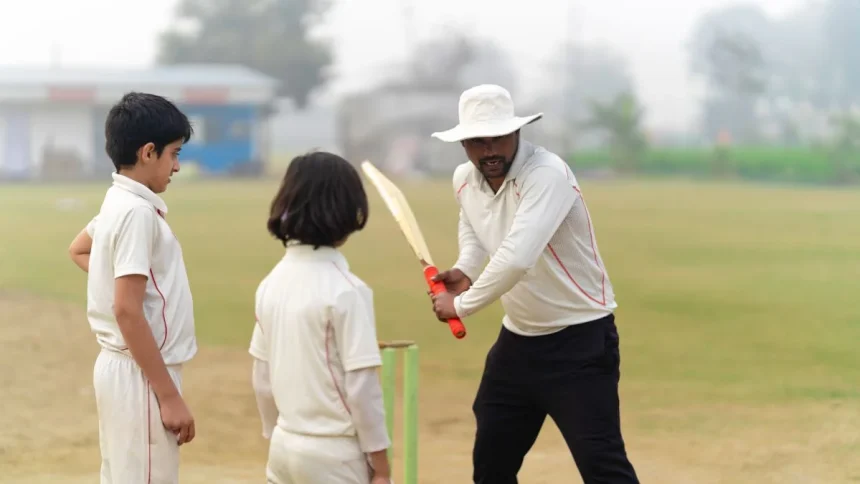
Cricket in India is not just for players and big tournaments anymore. Nowadays, people are really interested in helping kids learn cricket from a small age, and they invest a lot of money in their children to fine-tune their skills.
- Step 1: Build a Strong Foundation in Cricket
- Step 2: Earn a Cricket Coaching Certification
- Step 3: Start Coaching at the Grassroots Level
- Step 4: Develop Skills Beyond Cricket
- Step 5: Build Your Coaching Profile
- Step 6: Choose Your Coaching Path
- Step 6: Focus on Long-Term Growth
- Challenges You May Face as a Cricket Coach
Cricket coaching centres are opening everywhere, so being a cricket coach is a great job opportunity.
Not only parents, but schools are also making sure that kids get to play sports in a way, so they are always looking for good sports/ cricket coaches.
By being a cricket coach, you can make a practical way for people who love cricket, and you will also stay involved in the game.
If you used to play cricket, or even if you are a fitness trainer or if you just really love cricket, then this is a guide for you on how to become a coach in India.
Read More

Step 1: Build a Strong Foundation in Cricket
The first step is to develop a solid foundation, or we can say, the knowledge of cricket. Playing on the field experience is a plus point, but even if you haven’t ever played cricket professionally, you can still become a successful coach.
Focus on basics by learning:
- Batting techniques
- Bowling mechanics
- Fielding skills
- Match strategies
- Game awareness and tactics
Step 2: Earn a Cricket Coaching Certification
Certification is one of the most important steps in establishing credibility as a cricket coach.
Recognized coaching helps coaches learn structured training methods, player development techniques, and safety protocols. They also improve employment prospects at academies, schools, and sports institutions.
Popular certifications in India include:
- BCCI coaching programs
- State cricket association coaching courses
- Private cricket coaching institutes
While local coaching opportunities may be available without certification, obtaining formal qualifications significantly increases career growth opportunities.
Step 3: Start Coaching at the Grassroots Level
Experience is non-negotiable in any job. So, before getting somewhere big, try to start from the root level. Start your coaching career by assisting the senior coaches at local academies, joining the schools as a cricket coach, training small groups of the community, and conducting beginner sessions.
At this stage, the primary goal should be learning rather than earning. Real-world coaching experience helps develop practical skills that cannot be fully taught in a classroom.
Through this coaching, you will understand different players, common beginner-level mistakes, session management, communication and more.
Step 4: Develop Skills Beyond Cricket
Bookish knowledge alone is not enough to become a successful coach. Modern cricket coaching requires a combination of teaching, leadership, and management skills.
You need to focus on communication skills, players’ psychology, session management and discipline, injury awareness and basic fitness.
Step 5: Build Your Coaching Profile
In today’s digital age, visibility matters as much as expertise. Many talented coaches struggle to gain students simply because people are unaware of their services. Building an online presence can help establish credibility and attract more players.
So, try to show yourself more online, create a professional profile across social media and share your training videos and tips over there.
Step 6: Choose Your Coaching Path
As soon as you gain experience, you will have opportunities to specialize in different coaching roles. So, then you can choose what you want, i.e. being an academy coach, personal coach, institutional coach or high-performance coach for advanced players.
Step 6: Focus on Long-Term Growth
Being a cricket coach comes with a lot of patience and consistency. You cannot become successful in a year or so.
As your experience and reputation grow, opportunities often expand naturally for you. Many coaches begin with small local groups and eventually move on to coaching state-level or professional players.
Challenges You May Face as a Cricket Coach
A coaching career comes with a lot of hardships and challenges. You may face challenges like-
- Limited coaching opportunities
- Lower initial earnings
- Difficulty attracting students
- Competition from established coaches
But all of them will have just one solution: to be consistent and keep overcoming these problems.
Also Read: How To Start A Career In Cricket Analytics: Complete Beginner’s Guide