



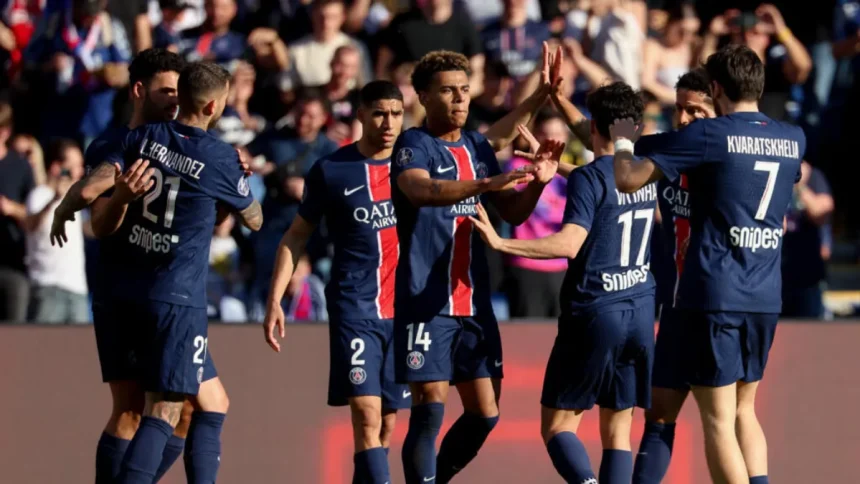
Paris Saint-Germain are no longer just a team built to dominate domestic competitions. This season, Paris Saint-Germain are clearly evolving with a sharper, more calculated approach tailored specifically for knockout football. The shift is visible not just in results but in how Paris Saint-Germain are structuring their squad, managing minutes, and adapting tactically to survive high-pressure European nights.
- Paris Saint-Germain Move Beyond the Galactico Model
- Tactical Flexibility Driving Paris Saint-Germain’s Knockout Edge
- Midfield Control Becoming Central to Paris Saint-Germain
- Squad Rotation and Load Management at Paris Saint-Germain
- Defensive Discipline Reshaping Paris Saint-Germain’s Identity
- Paris Saint-Germain’s Attack Now Built on Efficiency
- Leadership and Mentality Shift Within Paris Saint-Germain
Paris Saint-Germain Move Beyond the Galactico Model
For years, Paris Saint-Germain leaned heavily on individual brilliance, assembling superstar-heavy lineups that often lacked tactical balance. This season, Paris Saint-Germain have pivoted toward a more cohesive squad structure. Instead of stacking attacking names, the club has prioritized role-specific players who can execute system-based football under pressure.
The recruitment strategy reflects this transition. Midfielders with high work rates, defenders comfortable in compact systems, and versatile forwards have replaced the earlier emphasis on marquee signings. Paris Saint-Germain now resemble a unit designed for transitions, pressing triggers, and positional discipline rather than individual flair alone.
Tactical Flexibility Driving Paris Saint-Germain’s Knockout Edge
Knockout competitions demand adaptability, and Paris Saint-Germain are finally embracing tactical flexibility. The team has shown the ability to switch between formations depending on the opponent. Whether it is a back three for defensive stability or a fluid front line for counterattacks, Paris Saint-Germain are no longer rigid.
This flexibility allows Paris Saint-Germain to control different phases of the game. Against possession-heavy teams, they sit deeper and exploit transitions. Against defensive blocks, they stretch play using width and overlapping full-backs. This adaptability is critical in two-legged ties where game states shift rapidly.
Read More

Midfield Control Becoming Central to Paris Saint-Germain
A major structural change in Paris Saint-Germain this season is the emphasis on midfield control. In previous campaigns, the midfield often lacked defensive solidity and ball progression under pressure. Now, Paris Saint-Germain are focusing on balance between creativity and defensive coverage.
The midfield trio is tasked with maintaining compactness while also initiating quick transitions. Ball recovery, positional awareness, and tempo control are now key attributes. This evolution ensures Paris Saint-Germain can sustain pressure and avoid being overrun in high-stakes knockout matches.
Squad Rotation and Load Management at Paris Saint-Germain
Another critical adaptation is how Paris Saint-Germain are managing player workload. Knockout competitions require peak physical condition, and Paris Saint-Germain are rotating their squad more intelligently this season.

Key players are no longer overburdened in domestic fixtures. Instead, Paris Saint-Germain are distributing minutes across the squad to maintain freshness. This approach reduces injury risks and ensures the team is physically prepared for decisive European clashes.
Depth is being utilized strategically rather than reactively. Bench players are integrated into the system, allowing Paris Saint-Germain to maintain performance levels even with changes in personnel.
Defensive Discipline Reshaping Paris Saint-Germain’s Identity
Perhaps the most noticeable shift in Paris Saint-Germain is their defensive discipline. The team is more compact, with better spacing between lines and improved coordination in pressing.
Full-backs are more cautious in their forward runs, while center-backs are protected by a structured midfield shield. Paris Saint-Germain are conceding fewer high-quality chances because of this organized approach.
Set-piece defending, previously a vulnerability, has also improved. These marginal gains are often decisive in knockout football, where a single goal can determine the outcome of a tie.
Paris Saint-Germain’s Attack Now Built on Efficiency
While Paris Saint-Germain still possess attacking quality, the emphasis has shifted from volume to efficiency. Instead of relying on constant attacking waves, Paris Saint-Germain are focusing on creating high-quality chances.

The forward line is more disciplined in pressing and positioning. Quick transitions, intelligent runs, and better spacing are allowing Paris Saint-Germain to maximize scoring opportunities without exposing themselves defensively.
This balance between attack and defense is what separates knockout-ready teams from those built only for league dominance.
Leadership and Mentality Shift Within Paris Saint-Germain
Beyond tactics, Paris Saint-Germain are showing a stronger mental framework this season. Knockout competitions often test composure, and Paris Saint-Germain appear more resilient in difficult moments.
Leadership within the squad has become more distributed. Instead of relying on a few individuals, multiple players are stepping up to manage game situations. This collective responsibility is crucial in high-pressure environments.
Game management, particularly in closing out matches, has improved significantly. Paris Saint-Germain are making smarter decisions in possession and showing greater awareness of match context.