

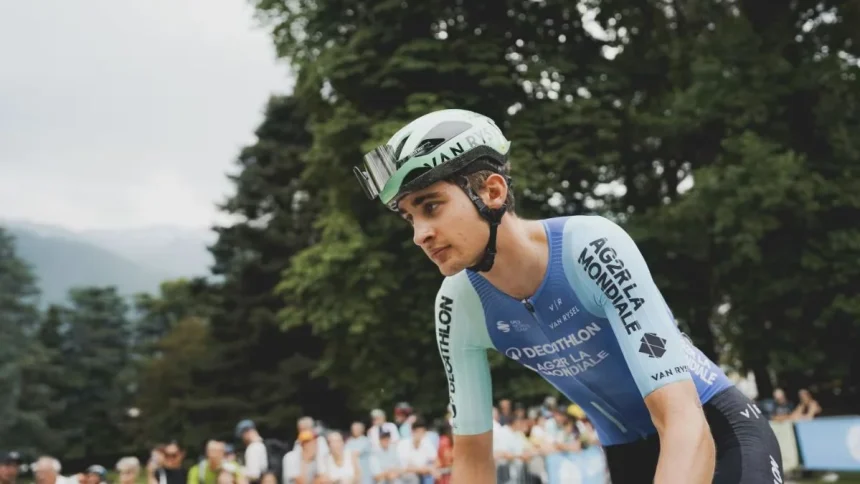
Paul Seixas, all of 19 years old, didn’t just finish his debut professional season with a flourish, but carved his name into cycling history. By finishing seventh at the Il Lombardia 2025, Seixas became the youngest rider to break into the top 10 in a Monument in more than a century, an astonishing feat made even more impressive by the names he bested and the path he took to get there.
For any other rider making their debut at a Monument, seventh place would be a career highlight. For Seixas, it was a learning moment- and, by his own admission, a slight disappointment.
Paul Seixas: History Made in Bergamo
Il Lombardia, known as “The Race of the Falling Leaves,” is one of cycling’s five Monuments- grueling, prestigious races that often define a rider’s legacy. In a year where Tadej Pogačar, Remco Evenepoel, and Egan Bernal were all on the start list, Seixas wasn’t expected to contend for the top places. Yet, by the end of the 238km test of attrition and skill, the French teenager had not only held on- he’d thrived, crossing the line in seventh and etching his name alongside history.
According to L’Équipe, the last time a rider this young finished in the top 10 of a Monument was 1917, when Luigi Cuppi, aged 18, placed fourth in Milan-San Remo. That kind of historical comparison underscores the magnitude of Seixas’ result.
From La Route to Lombardia: A Season Like No Other
Paul Seixas’ 2025 season has unfolded like the script of a rising star.

- Tour de l’Avenir Winner
In his only appearance at the under-23 level this season, Seixas dominated the prestigious “Tour of the Future,” confirming his status as one of the world’s best young stage racers.
- European Championships – Bronze Medalist
Racing against the elite, Seixas finished third, behind only the sport’s two current titans- Pogačar and Evenepoel.
- Il Lombardia – 7th Place
He outperformed several WorldTour veterans and Grand Tour winners in his first Monument.
In less than 12 months, Seixas has gone from a promising junior to a rider capable of competing at the highest level in the sport’s most demanding races.
High Standards, Higher Potential
Despite his historic performance, Seixas was visibly unsatisfied at the finish line in Bergamo.
“I’m a bit disappointed because I was in the right group, but then I was done, and the riders in front were stronger,” he admitted. “I gave everything, and that’s what I wanted to do today.”

It’s this mixture of realism and relentless ambition that makes Seixas so compelling. Where others would celebrate a breakthrough, he was dissecting the moment he lost positioning on the Passo di Ganda, and how that effort to chase back may have cost him a podium finish.
“Maybe it was the distance and the high pace, but I got caught out a bit on a descent. The effort I had to put in to get back probably cost me,” he reflected.
There’s an honesty and maturity in Seixas’ post-race analysis that belies his age. He knows what went wrong- but also what went right.
Belief Meets Belonging
By the time media questions reminded him of his historic feat, the teenager allowed himself a moment of perspective.
“At the end I was spent, I gave everything to get the best result, and seventh already is really good. I was too far back to fight with the podium group, so it’s a great way to end the season.”
More importantly, he acknowledged that this wasn’t just a physical milestone- but a psychological one too.
“I’ve passed a physical milestone but also a mental milestone, where I can now tell myself that I have a place among the best riders.”
That sense of belonging is critical. Many young talents arrive with big numbers and big hype, but few make the mental leap as quickly as Seixas seems to have. The ability to suffer, to assess, and to still believe- those are the ingredients of greatness.
Also Read: Cycling Monuments: 5 Greatest One-Day Races
The Future Is Now
French cycling has long awaited its next generational superstar. Paul Seixas, born in late September 2006, looks poised to take that mantle. Competing not just at WorldTour level, but at the sharp end of elite races, he’s already setting a new standard for what’s possible at 19.
His Decathlon AG2R La Mondiale team has managed him with striking balance- giving him the freedom to race with the best while sparingly using the U23 circuit to build confidence and results.
As 2026 looms, there will be inevitable comparisons to Pogačar, Evenepoel, and other prodigies. But Seixas doesn’t need to follow anyone’s trajectory. He’s already carving out his own.