


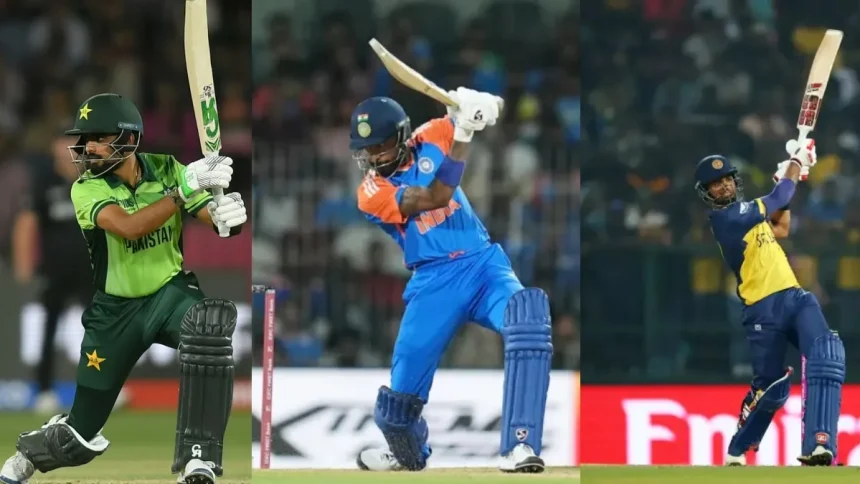
In the T20 World Cup 2026, we saw many teams go through ups and downs, but the teams that faced the most trouble were those whose middle order was weak or not effective. India, Pakistan, and Sri Lanka were at the top of this list. These teams played good cricket, but in the end, their lower order came under heavy pressure, and many matches went very close.
Not only India, Pakistan, and Sri Lanka, but the UAE also failed to build long partnerships in the middle overs, and Australia lost early wickets and, because of a weak middle order, could not qualify for the Super 8s. These problems prevented teams from consistently scoring big totals and winning important matches.
India’s Middle-Over Offspin Trouble in T20 World Cup 2026
In the T20 World Cup 2026, India struggled badly in the middle overs against offspin bowling. Players like Abhishek Sharma, Suryakumar Yadav, and Hardik Pandya found it hard to score freely. India managed only 6.23 runs per over in this phase, one of the lowest rates in the tournament. This slow scoring built pressure and often stopped India from posting big totals.
Pakistan Middle-Order Struggles Hurt T20 World Cup 2026
Pakistan’s T20 World Cup 2026 campaign showed a big weakness in the middle order. Captain Salman Ali Agha said this problem has existed for years. Openers Babar Azam and Mohammad Rizwan often gave strong starts, but players like Iftikhar Ahmed, Shadab Khan, and others could not continue the momentum.
Quick wickets in the middle overs caused collapses and pressure. Because runs slowed after good starts, Pakistan failed to finish matches strongly and were eliminated early.
Read More

Sri Lanka Middle-Order Problems in T20 World Cup 2026
In the T20 World Cup 2026, Sri Lanka faced major batting problems during the middle overs, especially between the 7th and 15th overs. The team struggled to rotate strike and hit boundaries regularly. Top-order players like Pathum Nissanka and Kusal Mendis could not always provide strong starts.
The middle and lower orders depended heavily on Kamindu Mendis and Dasun Shanaka to control scoring. Because partnerships were missing, Sri Lanka often lost momentum and failed to post competitive totals consistently.
ALSO READ: How To Become A Skilled Cheerleader?