

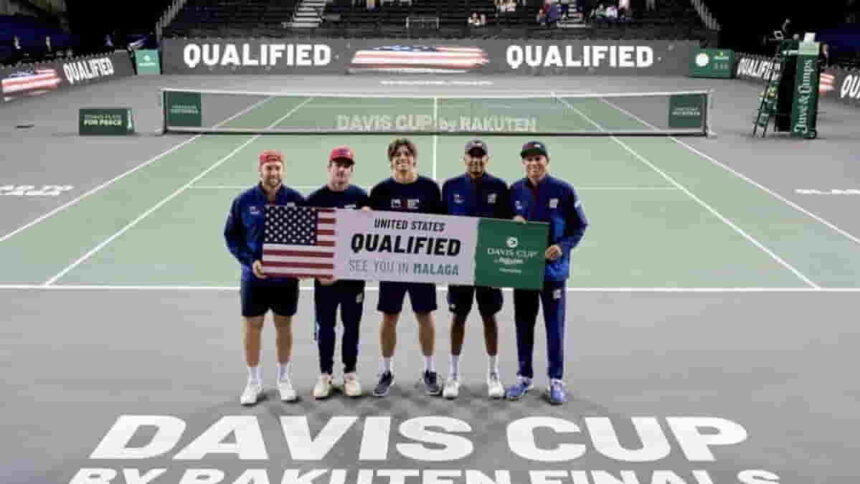
The Davis Cup is one of the most well-known tennis competitions and is very well-liked all over the world. What about its background and organizational structure make it so outstanding? More than a century ago, some of the greatest tennis competitions in sports history got their start. One of the factors contributing to the competition’s notoriety is its rich history. The Davis Cup is one of the few competitions that players hold in high regard because it no longer represents each player individually. The tournament’s origins date back to 1900 when it was first envisioned as a contest between the United States and Great Britain.
History:
James Dwight, the founding president of the American National Lawn Tennis Association in 1881, is likely the person who had the idea for a competition putting the top British and American players against one another. He worked relentlessly to involve British officials in a fully sanctioned match because he was desperate to evaluate the progress of American players against the known British champions but was unable to do so. Nevertheless, he tried to lure top international (especially British) talent to the United States and approved semi-official trips to Great Britain for the best American players.
International competitions had been held for several years before the first Davis Cup match in 1900. England and Ireland started in 1892. In the tournament’s popular magazine, the notion was addressed, and Dwight F. Davis’s name was offered as someone who might “do something for the game.” Davis was present during the event.
What is the Davis Cup?
Read More


The World Cup of tennis is named as the famous Davis Cup. Dwight Davis founded the largest yearly international competition squad in all of the sports in 1900. Great Britain is the only nation to compete in every tournament. It has won the trophy ten times, with 2015 being the most recent year.
What is the Davis Cup Format?
The Davis Cup by Rakuten Finals will begin in March of 2022 with qualifying games to decide whether nations advance to the group stages in September. The Davis Cup by Rakuten Finals will begin in March 2022 with qualifying games to decide whether nations advance to the group stages in September. With 16 nations vying for the top spot, the group stages will be spread among four cities: Glasgow, Bologna, Hamburg, and Valencia. 12 winners from the preliminary rounds, the two last year’s finalists, and two more wild cards.
Read More

Winners:
In 1900, the first contest between the two countries was held. It was so successful that it became necessary to hold it frequently as a legitimate competition. One of the initial competitors, Dwight Davis, created the original tournament format. Later, the American decided to use his funds to create the first trophy. Before being renamed the Davis Cup, the competition was known as the International Lawn Tennis Challenge. The trophy was designed by William Durgin and made by Rowland Rhodes. For the Davis Cup, 1969 was a significant year because it was the first time that 50 nations participated.
Structure:
After the 16-nation World Group format was introduced in 1981, the history of the Davis Cup was altered. The tournament’s large participant count indicates that Coupe Davis is getting more and more competitive. To put things in perspective, more than 130 countries will compete in the tournament’s 2021 edition.
Currently, the world group of 16 nations has the chance to compete for the title in the closing rounds. However, initially, nations are grouped according to their regional makeup. The Americas zone, Europe/Africa zone, and Asia/Oceania zone are the three main divisions.
They are further separated into groups in descending order according to their ranking. For instance, the Americas zone is divided into three groups, which include a total of 23 nations. There are two groups in the Europe/Africa zone, each with 28 countries. However, these groups are further divided into separate European and African groups, each with 14 countries.
Read More

Tennis Davis Cup tournaments employ the tie-breaking procedure to oust defeated teams, just like other tennis cup competitions. Five rubbers (the Davis Cup designation for individual games) make up each match, four of which are singles matches with a doubles game in the middle. The first two singles rubbers take place at the beginning of the match, while the opposite happens in the closing stages of the contest.
| 4-5 March | 13-18 September | 22-27 November | TBC |
| Finals – qualifiers
World Group l & ll play-offs |
Finals – Group Stage
World Group l & ll |
Finals – Knock-out stages | Group lll & lV regional events |
2022 Davis Cup Finals Groups:
| Group A | Group B | Group C | Group D |
| Argentina | Canada | Australia | Great Britain |
| Croatia | Serbia | Belgium | Kazakhstan |
| Italy | South Korea | France | Netherlands |
| Sweden | Spain | Germany | USA |
2022 Davis Cup Finals Group Stage Schedule and Results:
| Date | Match | Group Venue | Result |
| 13-Sep | Argentina vs Sweden | A Bologna | 2-1 |
| 13-Sep | Canada vs South Korea | B Valencia | 2-1 |
| 13-Sep | Belgium vs Australia | C Hamburg | 0-3 |
| 13-Sep | Kazakhstan vs Netherlands | D Glasgow | 1-2 |
| 14-Sep | Croatia vs Italy | A Bologna | 0-3 |
| 14-Sep | Spain vs Serbia | B Valencia | 3-0 |
| 14-Sep | France vs Germany | C Hamburg | 1-2 |
| 14-Sep | Great Britain vs USA | D Glasgow | 1-2 |
| 15-Sep | Croatia vs Sweden | A Bologna | 2-1 |
| 15-Sep | Serbia vs South Korea | B Valencia | 2-1 |
| 15-Sep | France vs Australia | C Hamburg | 1-2 |
| 15-Sep | USA vs Kazakhstan | D Glasgow | 2-1 |
| 16-Sep | Italy vs Argentina | A Bologna | 2-1 |
| 16-Sep | Spain vs Canada | B Valencia | 1-2 |
| 16-Sep | Germany vs Belgium | C Hamburg | 2-1 |
| 16-Sep | Great Britain vs Netherlands | D Glasgow | 1-2 |
| 17-Sep | Canada vs Serbia | B Valencia | 1-2 |
| 17-Sep | France vs Belgium | C Hamburg | 2-1 |
| 17-Sep | USA vs Netherlands | D Glasgow | 1-2 |
| 18-Sep | Italy vs Sweden | A Bologna | 2-1 |
| 18-Sep | Spain vs South Korea | B Valencia | 3-0 |
| 18-Sep | Germany vs Australia | C Hamburg | 2-1 |
| 18-Sep | Great Britain vs Kazakhstan | D Glasgow | 2-1 |
“Get more sports news, cricket news, and football updates, log on to sportsdigest.in. Follow us on Facebook or Twitter and Subscribe to our YouTube Channel.”