Cristiano Ronaldo’s Evolution: How He Reinvented His Game Across Three Decades of Elite Football
Cristiano Ronaldo’s football journey is not just a story of goals, trophies, or records. It is a story of constant reinvention. From a raw winger driven by flair to a disciplined goal scorer shaped by intelligence and positioning, Ronaldo’s career shows how adaptation is key to long-term success at the highest level.
Across different leagues, tactical systems, and stages of his physical peak, Ronaldo adjusted his game to remain effective. His evolution reflects changes in football itself, but more importantly, it highlights his ability to understand his body, his role, and the demands of elite competition.
Early Years: A Flair-Driven Winger at Sporting CP and Manchester United
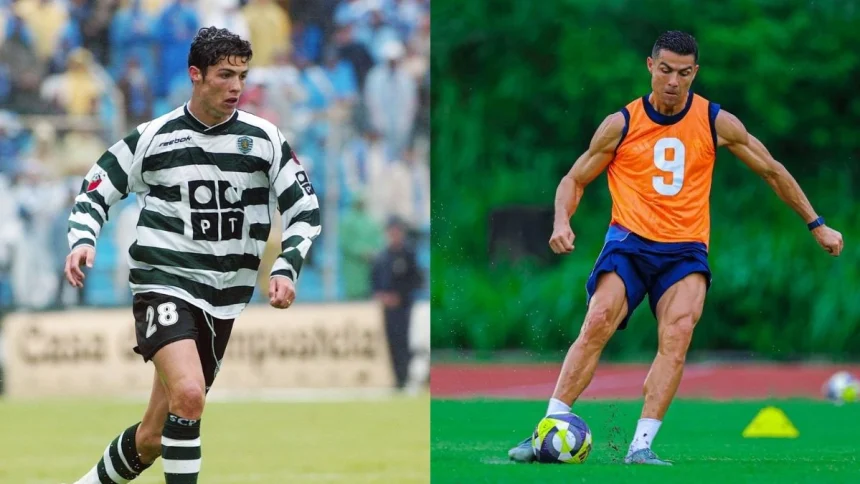
Cristiano Ronaldo first emerged as a right winger known for pace, dribbling, and technical tricks. During his early days at Sporting CP and his initial seasons at Manchester United, his game was built around taking on defenders, stretching the pitch, and creating excitement on the wings.
At this stage, Ronaldo’s primary strengths were his speed, confidence, and ability to beat players in one-on-one situations. He often stayed wide, focusing on delivering crosses or cutting inside to create shooting chances. His role was less about scoring regularly and more about providing attacking unpredictability.
This version of Ronaldo reflected a young player learning the professional game. While his talent was clear, his output was still developing, and his decision-making continued to mature with experience.

Manchester United: From Showmanship to Efficiency
Ronaldo’s time at Manchester United marked the first major transformation of his career. As seasons progressed, he reduced unnecessary flair and began focusing more on end product. By the later years of his first spell at the club, he became a consistent goal threat rather than just a creative winger.
This shift saw Ronaldo attack central areas more often, arrive in the box at the right moments, and improve his finishing. His dribbling became more purposeful, and his movement without the ball gained importance.
The evolution at United showed Ronaldo’s growing understanding of how matches are decided. He learned when to take risks and when to play simple, laying the foundation for the goal-focused forward he would later become.

Real Madrid: The Complete Attacker and Tactical Freedom
Ronaldo’s move to Real Madrid marked the most decisive phase of his evolution. While he initially continued to start from wide positions, his role gradually changed into that of a free-roaming attacker and later a more central forward.
As his career progressed in Spain, Ronaldo relied less on constant dribbling and more on intelligent movement, positioning, and finishing. He conserved energy, choosing moments carefully and maximising his impact inside the penalty area.
This period highlighted his tactical maturity. Ronaldo adapted his style to the demands of elite football and the physical realities of ageing, proving that effectiveness does not depend solely on speed or flair.
Juventus Years: Tactical Flexibility and Positional Awareness
At Juventus, Ronaldo displayed another layer of evolution by adapting to a league known for its tactical discipline. He operated in multiple attacking roles, sometimes drifting wide and at other times playing closer to goal.
His game became more balanced, contributing to build-up play while maintaining his scoring threat. This phase showed his willingness to adjust to different systems and responsibilities rather than forcing the team to adapt entirely around him.
Ronaldo’s experience and positional intelligence became key tools, allowing him to influence games even when physical advantages were less dominant than earlier in his career.
Read More

Physical Adaptation and Longevity at the Elite Level
One of the most important aspects of Cristiano Ronaldo’s evolution has been his physical and mental adaptation. As pace naturally declined with age, his intelligence, movement, and efficiency improved.
Rather than relying on constant acceleration, he focused on timing, anticipation, and smart positioning. This approach allowed him to remain competitive well into his mid-thirties and beyond, a rarity in modern football.
His evolution serves as an example of how elite players can extend their careers by understanding their strengths and adjusting their style to new realities.
What Cristiano Ronaldo’s Evolution Represents
Cristiano Ronaldo’s career is proof that longevity in football requires more than talent. It demands self-awareness, discipline, and the courage to change. Each stage of his career represents a different version of success, shaped by learning and adaptation.
His journey from winger to central attacker reflects not just personal growth but also a deep understanding of football’s tactical and physical demands. This evolution is what separates him from many great players who struggled to adapt over time.
Cristiano Ronaldo’s evolution is one of the defining stories of modern football. Across clubs, leagues, and decades, he continuously reshaped his game to remain effective at the highest level.
From a flair-driven winger to a calculated and efficient attacker, his journey shows that true greatness lies in the ability to adapt. Ronaldo’s career is not just a collection of moments but a long-term masterclass in football intelligence and reinvention.
Also Read- The Rise And Fall Of Golden Generations In Football