

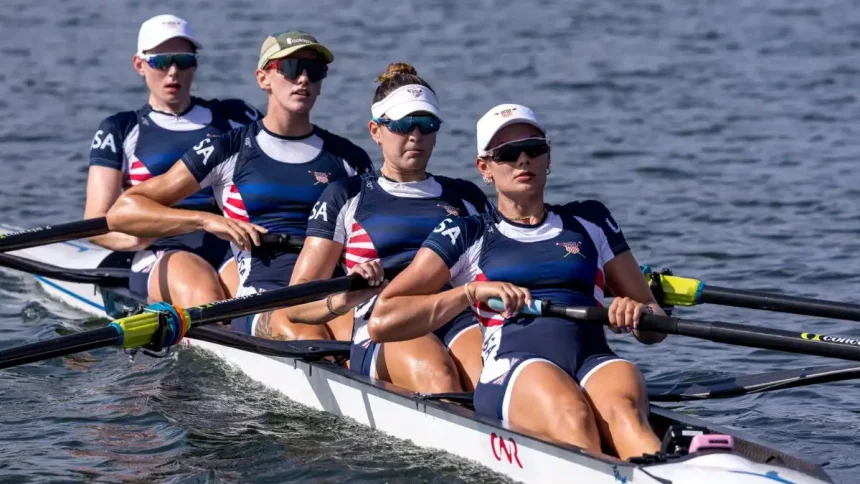
Rowing’s Evolution has propelled the sport far beyond its ancient roots of manpower and simple oar leverage into a high-precision athletic discipline where minutiae in movement, timing, and science now separate the winners from the rest. Today, rowing is not just about strength; it’s about the marriage of biomechanics, synchronization, and meticulous data-driven coaching that turns crews into finely tuned machines.
From Ancient Muscle to Modern Mastery: The Legacy Behind Rowing’s Evolution
From the Nile’s first gliding vessels to the electrifying sprints at the World Rowing Championships, competitive rowing has a storied history that blends tradition with relentless innovation. Early athletes relied predominantly on raw power and endurance, but as the sport matured, the emphasis shifted toward body mechanics, fluid dynamics, and training efficiency. The introduction of sliding seats in the 19th century expanded the role of the athlete’s legs, revolutionising stroke effectiveness and setting the stage for technique-centred performance.
When Milliseconds Matter: Technique as the Engine of Performance
In the modern era, rowing technique is a science in itself. Coaches and sports scientists scrutinize every phase of the stroke, from the catch (blade entry) to the drive (power application) and the recovery, to optimize force transfer and minimize energy waste. Advanced measurement systems, including sensor-based wireless devices that capture muscle activation and motion patterns, have become standard tools for elite crews. These systems deliver precise biomechanical feedback that allows athletes to fine-tune their strokes in ways that were unimaginable even a decade ago.
What coaches once judged by eye is now quantified digitally, enabling individualized tweaks that shave precious tenths of seconds off race times. Even on ergometers, the stationary rowing machines used for indoor training, emerging studies underscore how stroke rate interacts with technique and core stability, affecting overall performance in measurable ways.
Dance on Water: Synchronization’s Undeniable Impact on Speed
Rowing is unique among sports in its acute reliance on teamwork, synchronization is not optional; it’s fundamental. When a crew rows in unison, the force produced by each athlete combines seamlessly through the hull, generating propulsion orders of magnitude greater than the sum of individual efforts. Research into synchronized and asynchronous rowing shows that perfect timing reduces speed fluctuations and increases effective power output, a difference evident in elite racing where margins of victory are measured in fractions of a second.
Read More

Historically, crews that failed to row together suffered increased drag and lost precious momentum as the boat oscillated under uneven forces. These subtle imbalances translate into tangible time losses and the teams that invest in drilling perfect synchronization often find themselves consistently on the podium at major events like the World Rowing Championships.
Science on the Sidelines: Sports Science Redefining Training and Recovery
Sports science has injected a new level of sophistication into rowing training program. Rather than relying solely on volume, coaches now design workouts that target specific physiological and neuromuscular adaptations. Intervals, lactate threshold monitoring, and neuromuscular activation studies inform tailored sessions that elevate rowing efficiency without risking overtraining.
Biomechanics and hydrodynamics research continues to refine our understanding of how force interacts with water and muscle output. This includes studying how joint angles, body velocities, and stroke sequencing differ between athletes and what that means for propulsion efficiency, insights that feed directly into technical coaching cues and customized drills.

Sports science isn’t limited to the water. Ergometer data is now as valuable as on-water performance metrics. Coaches compare virtual and real-world output, applying findings from connected rowers and indoor competitions to water sessions in ways that enhance race readiness and competitive resilience.
The Competitive Edge: Championships Now Won on Preparation, Not Just Power
The modern World Rowing Championships illustrate rowing’s evolution into a sport where elite competition demands unparalleled technique, flawless synchronization, and cutting-edge science. Each year, crews from across the globe converge to contest over 2000 meters of water, where preparation, down to the smallest biomechanical and technical detail, dictates results.
In this new era, equipment innovation also plays a role. Lighter shells, more efficient oars, and enhanced monitoring gadgets ensure that physical output is translated into forward motion with minimal loss. Combined with data-driven coaching and biomechanical insights, athletes are now operating closer to perfection than at any other time in rowing history.
Also Read: A Simple Guide To Coastal Rowing