
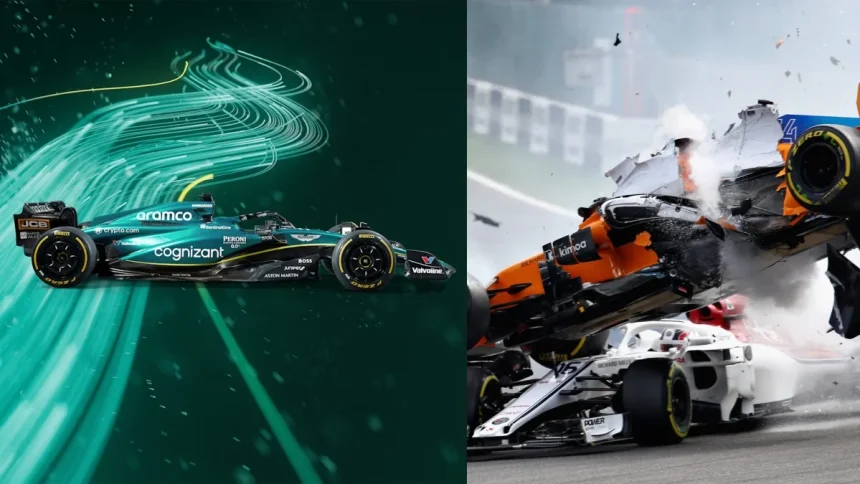
The 2026 Aston Martin F1 car, called AMR26, was designed with help from Adrian Newey. The team focused strongly on safety and performance. It has a stronger roll hoop that can survive 20g crash forces. The survival cell is made from advanced carbon fiber composite to keep the driver safe. The car also uses a push-rod suspension with high inboard pickup points, helping manage the new 8.5MJ per lap energy harvesting system used in 2026 Formula 1 cars.
Aston Martin F1 Improves Safety With Stronger Roll Hoop
The Aston Martin F1 team follows new safety rules to make their cars safer for drivers. One big change is stronger crash test requirements. The roll hoop, which is the structure above the driver’s head, must now handle a 20g load during testing. This means it can survive forces 20 times stronger than gravity in a crash. These improvements increase the car’s structural integrity and help protect the driver better during serious Formula 1 accidents.
Aston Martin F1 Suspension Design Improves Safety Control
The Aston Martin F1 car uses a push-rod suspension system on all four wheels to improve safety and control. This setup helps manage heavy loads created when the car brakes, turns, and drives at high speed. The rear suspension is mounted higher on the car, which helps balance forces better and keeps the car stable. Because of this design, drivers get smoother handling and better control, making the car safer and more predictable during races.
Aston Martin F1 Braking System Uses Smart Energy Control
The Aston Martin F1 car uses an advanced braking system to handle modern Formula 1 technology. The MGU-K can recover up to 8.5MJ of energy every lap, so braking is more complex than before. The car combines regenerative braking, which saves energy, with normal hydraulic friction brakes for stopping power. A rear brake-by-wire system controls braking electronically, helping balance safety, control, and performance while the car slows down at very high speeds.
Aston Martin F1 Cockpit Design Improves Driver Protection
The Aston Martin F1 car has a special cockpit design made to protect the driver better. A vertical fin is placed beside the headrest near the driver’s helmet. This fin helps control airflow around the cockpit when the car moves at very high speeds. It also reduces helmet buffeting, which means less shaking caused by strong air pressure. Because of this design, the driver feels more stable, comfortable, and safer during fast racing conditions.