

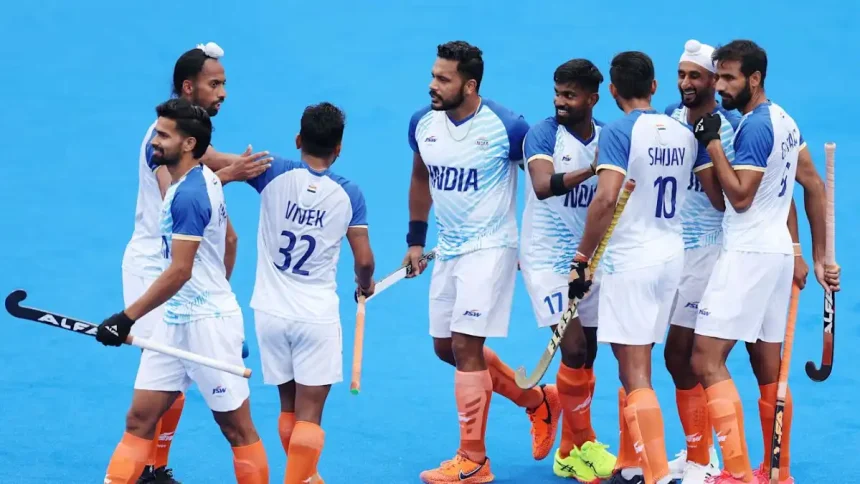
India’s evolution in field hockey is no longer just about flair and fast breaks. The modern game demands structured pressing, spatial awareness, and coordinated defensive triggers, and the Indian men’s team has steadily recalibrated its identity to meet these tactical demands. In today’s elite field hockey, pressing is not an isolated defensive act but a collective system that dictates tempo, transitions, and territorial control.
From Counter-Attack to Controlled Field Hockey Pressing
For years, India’s approach in field hockey revolved around speed-driven counter-attacks, built on the classic “steal, sprint, score” philosophy. That blueprint is now being refined. Under coach Craig Fulton, the team has shifted towards a more structured pressing model, reducing all-out high pressing and adopting a balanced half-court press.
This transition reflects a broader tactical evolution in field hockey, where relentless pressing is often replaced by calculated pressure zones. Instead of chasing the ball aggressively across the pitch, India now focuses on compressing space in midfield and forcing turnovers in controlled areas. The emphasis has moved toward shape retention and intelligent positioning rather than raw intensity.
Understanding Tactical Pressing in Modern Field Hockey
Pressing in field hockey is fundamentally about restricting passing lanes and channeling opponents into predictable spaces. It requires synchronized team movement, with forwards initiating pressure and midfielders and defenders closing gaps behind them.
In modern field hockey, pressing systems are typically divided into high press, mid-block, and low-block structures. India’s adaptation lies in blending these systems situationally. Rather than committing to a single pressing style, the team adjusts based on opposition build-up patterns and match context.
Read More

This flexibility is crucial because elite teams exploit disorganized presses. A mistimed press can open vertical lanes, leaving defensive lines exposed. India’s tactical shift aims to eliminate these vulnerabilities by prioritizing compactness and communication.
Field Hockey Pressing Triggers and System Discipline
One of the most significant upgrades in India’s field hockey structure is the use of pressing triggers. These are specific cues that signal when to initiate pressure, such as a poor first touch, a backward pass, or an opponent receiving the ball near the sideline.
The forwards play a decisive role here. As noted by former coach Graham Reid, forward-led pressing sets the tone for the entire defensive unit, often leading to high-value turnovers in advanced areas.

India’s pressing system now emphasizes coordinated waves rather than individual efforts. When the first line presses, the midfield compresses immediately, ensuring numerical superiority around the ball. This aligns with a core principle of field hockey tactics: creating overloads to regain possession efficiently.
Switching Flanks and Build-Up Play in Field Hockey
Another notable adjustment in India’s field hockey approach is the integration of structured build-up play alongside pressing. The team is increasingly using lateral ball movement and flank switches to destabilize opposition pressing systems.
This dual approach serves two purposes. First, it reduces predictability in possession. Second, it allows India to control the rhythm of the game rather than reacting to it. By combining pressing with patient build-up, the team is developing a more complete tactical profile suited for high-level competitions.
Modern field hockey rewards teams that can seamlessly transition between defensive pressure and attacking organization. India’s evolving system reflects this demand, with players trained to operate within tight positional frameworks.
Adaptability as the Core of India’s Field Hockey Evolution
Adaptability has become the defining trait of India’s current field hockey setup. The coaching staff has repeatedly emphasized the importance of players adjusting quickly to new tactical systems, especially in high-pressure tournaments.
This adaptability is evident in how India modifies its pressing intensity against different opponents. Against possession-heavy teams like Belgium or the Netherlands, India often employs a mid-block press to conserve energy and maintain defensive shape. Against weaker build-up sides, the press becomes more aggressive and higher up the pitch.
Read More

Such situational awareness is essential in modern field hockey, where matches are often decided by small tactical margins. The ability to switch pressing gears within phases of play gives India a competitive edge.
The Physical and Cognitive Demands of Field Hockey Pressing
Tactical pressing in field hockey is as much a mental exercise as it is physical. Players must constantly read the game, anticipate passing patterns, and make split-second decisions. This cognitive load is significantly higher in structured pressing systems compared to traditional man-to-man marking.
India’s training methods now reflect this reality. Conditioning drills are integrated with tactical scenarios, ensuring players can sustain pressing intensity while maintaining positional discipline. The focus is on repeat sprint ability, recovery positioning, and decision-making under fatigue.
In modern field hockey, pressing is not about chasing the ball endlessly. It is about timing, coordination, and exploiting moments of weakness. India’s transition toward this nuanced understanding highlights a broader maturity in their tactical framework.
Also Read: Top 10 Most-Valuable NHL Teams