
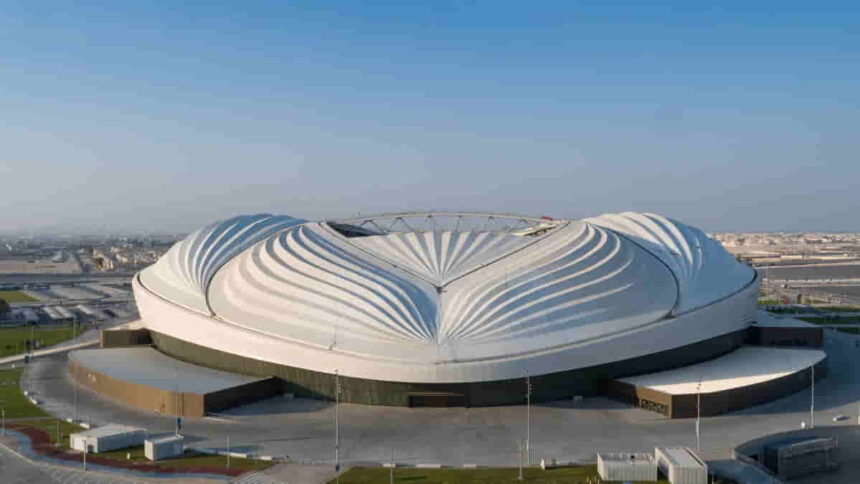
The Emirates Cup final was played during the facility’s launch on May 16, 2019, when it was officially opened. The stadium, which was the second location for the FIFA World Cup (after Khalifa International Stadium), was prepared for the event. It was also the first stadium that was entirely new.
What distinguishing qualities does Al Janoub Stadium have?
The arena is situated in Al-Wakra, a Persian Gulf city close to Doha (the stadium is less than 20 km from the centre of the capital). Al Janoub Stadium, which means “the stadium of the south,” refers to the fact that it is the Qatari World Cup’s southernmost venue.
This was the first stadium in the firm’s portfolio, and it was created by the renowned Zaha Hadid studio in Iraq in cooperation with AECOM. The building’s design is influenced by regional customs; in Al-Wakra, people have been fishing and pearl-diving for centuries while using the distinctive ‘dhow’ sailing boats.
The stadium’s shape and leitmotif were inspired by patterns found on these sailboats. The domed ceiling is intended to inspire sailboats from the outside; the structure evokes a ship’s hull from below; and the seating in the stands are arranged to resemble sea waves.

The stadium has attracted a lot of media attention for the perception of its appearance, which, nevertheless, differs greatly from the official version. The outside of the stadium was likened to female genitalia shortly after the visualization was released (in the fall of 2013), leading some to speculate that it was more like a woman’s vagina than a conventional boat. Even the idea that it was a feminist manifesto to promote women’s rights in the Middle East was tossed around. Zaha Hadid, however, vehemently refuted such stories.
As one of the two FIFA World Cup venues (alongside Al Bayt Stadium), the stadium has been equipped with a retractable roof. The innovative system is somewhat reminiscent of the one used, for example, at the National Stadium in Warsaw.