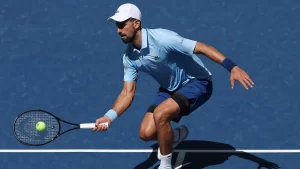

Dhakshineswar Suresh was not supposed to be the story of India’s Davis Cup tie against the Netherlands. Ranked outside the world’s top 450, playing only his second tie, and still completing his college degree in the United States, he was meant to be a supporting character. And then, on a loud weekend in Bengaluru, the 6-foot-5 right-hander with a thunderous serve and an unshakeable calm rewrote the script. He walked away as the face of one of India’s most memorable Davis Cup victories in recent history.
By Sunday night at the S.M. Krishna Tennis Stadium, Suresh had done something no Indian player had managed in over two decades. He won all three rubbers he played- two singles and a decisive doubles- powering India to a historic 3–2 win and into the second round of the Davis Cup Qualifiers for the first time since the format was introduced in 2019. The last Indian to achieve a similar clean sweep? Leander Paes, back in 2004.
This wasn’t just a breakout. It was a statement.
Dhakshineswar Suresh: Built Different
Standing at 6 feet 5 inches, Dhakshineswar Suresh brings a physical profile Indian singles tennis has rarely seen. His game reflects it. There is no disguising his identity on court — a booming first serve, heavy forehands struck with intent, and a willingness to dictate from the baseline rather than improvise at the net.
When his serve lands, it doesn’t just start points; it controls them. Against the Netherlands, Suresh held serve relentlessly, never once getting broken across three matches. In the decisive fifth rubber against Guy den Ouden, he fired ace after ace, stretching angles that made returning feel more like survival than strategy.

This was not the traditional Indian Davis Cup playbook. This was modern tennis- power-oriented, first-strike, and unapologetically aggressive.
From Madurai to the Big Stage
Born in Madurai, Tamil Nadu, Suresh’s path to this moment has been anything but conventional. While many Indian players grind their way through the domestic circuit and early professional events, DK took a different route- one that quietly prepared him for exactly this kind of pressure.
He honed his game in the United States collegiate system, first dominating at Georgia Gwinnett College, where he won multiple NAIA titles, before stepping up to NCAA Division I tennis with Wake Forest University. There, in one of the most competitive college conferences in the country, he developed not just his physical base, but something arguably more valuable: composure.

College tennis, with its relentless schedule, team-driven intensity, and frequent high-stakes matches, forged a player who looked completely at home under Davis Cup pressure. At Wake Forest, Suresh earned All-American honours and built a reputation as someone who showed up when matches tightened.
That education was on full display in Bengaluru.
Thriving Where Others Shrink
What separated Suresh from everyone else on court that weekend was not just his serve or his forehand. It was his emotional control.
With India’s singles No.1 Sumit Nagal struggling through a hip injury and losing both his singles matches, the tie repeatedly swung into dangerous territory. Each time, Suresh responded with calm, controlled aggression. He dismantled world No.88 Jesper de Jong in straight sets, partnered Yuki Bhambri to win a marathon doubles match that gave India a crucial edge, and then returned- physically drained but mentally locked in- to seal the tie in the deciding singles.
Playing two matches in one day, after hours on court, Suresh showed no visible panic. His first-serve percentage stayed high. His shot selection remained disciplined. When the final forehand landed and India’s victory was secured, he collapsed onto the court- not in disbelief, but in sheer exhaustion.
It was the image of a player who had emptied everything he had.

More Than a Prospect
Suresh’s professional ranking- hovering in the mid-400s- tells only a fraction of the story. He does not yet play a full ATP Tour schedule, balancing his competitive tennis with completing a communication studies degree at Wake Forest, which he is set to finish later this year.
But signs of his upward curve have been visible for a while. In December 2023, he stunned former world No.1 Daniil Medvedev at the World Tennis League in Bengaluru. In recent Challenger events, he has shown an increasing ability to beat higher-ranked opponents and escape tight situations. Indian tennis recognised the trajectory, naming him ITD Male Player of the Year in 2025.
The Davis Cup, however, has a way of fast-tracking reputations. And in one weekend, Suresh went from promising name to national reference point.
Also Read: Novak Djokovic To Represent Serbia In Davis Cup Despite Move To Greece?
The Beginning, Not the Peak
For all the hype, Suresh himself has remained grounded. He has described this run as “just the beginning,” fully aware that the real test lies ahead- transitioning into full-time life on the ATP Tour, week after week, without the protective bubble of a team environment.
India’s next challenge awaits in September, away against South Korea, with a place in the Davis Cup Finals on the line. By then, Dhakshineswar Suresh may no longer be an underdog unknown to the wider tennis world.
What Bengaluru proved is that Indian tennis has, perhaps quietly, entered a new phase. One where power matches poise. Where size meets stamina. And where pressure does not intimidate- it sharpens.
In the south of India, the name Dhakshineswar means “God of the South.” For one unforgettable weekend, Indian tennis watched a player live up to something close to that billing.