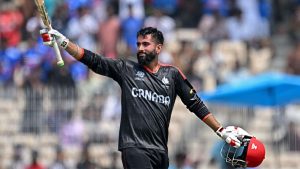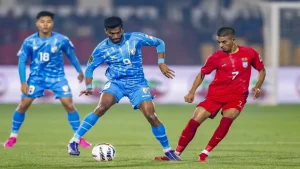

On Tuesday, the men’s national team hit a low it hadn’t since away losses to Pakistan in 2005 (0-3) and Guam (0-1) in 2015. Threading three defeats, the one in Guwahati included, in three decades is Sunil Chhetri. Football is game where 11 play 11 but he is possibly the most important reason why “the kid in Andaman or Uttar Pradesh” still follow the Blue Tigers ignoring results that have been largely underwhelming.
No matter how many what-if moments you glean from the games against Afghanistan – Manvir Singh’s misses in both, Vikram Partap Singh’s header in Abha, the late penalty because the defenders were poorly positioned and Gurpreet Singh Sandhu too deep in his box (a gut-wrencher that, it could be the reason for another second-round exit) – it is difficult to mask how insipid India were.
Lacking creative spark
Missing was the creative spark that fetched goals on way to three tournament wins in 2023. When not corralled into corners, India played poor crosses, which may also be a pointer to better full-backs in international football; opponents who can stop wide players from using their stronger foot.
There was little play through the middle and India had two shots on target in over 180 minutes of football against opponents 41 slots below them in FIFA rankings. Igor Stimac pointed out India going to the front third and playing a back-pass after the 1-2 loss in Guwahati.
Read More

What happens in one area of the pitch affects another and contributed to Afghanistan’s smash-and-grab win. With a bit of luck they could have won at home too. Afghanistan and Palestine, who beat Bangladesh 1-0, were the flavour of this round of the 2026 World Cup qualifiers in Asia.
As were Ukraine in successfully sealing an Euro 2024 berth. Like Iraq in 2007, these teams have shown that while football is not matter of life and death, and certainly not more important, it can provide battle-scarred countries moments of succour.
“Why not” said Afghanistan coach Ashley Westwood when asked if they could qualify for the third round. They have a whoppingly negative goal difference to contend with but it is now a three-way battle for the second spot in Group A. In his moment of glory, Westwood also showed grace saying Stimac has done a “fantastic” job.

Pressure on Stimac
Till last November, when India beat Kuwait for their first away World Cup qualifier win in 22 years, Stimac was the fans’ favourite. On Tuesday, he was booed and abused by a section of the fans. Stimac radiates positivity, it is how he is. After apologising for the inert performance, the India head coach said a never-before third round in the World Cup qualifiers is possible; it is, beat Kuwait on June 6 and history will be made.
Assuming All India Football Federation (AIFF) don’t add to the mess by removing him, Stimac is likely to prepare a longlist of probables and get the players to work like he did before last year’s Inter-continental Cup. He said he was confident that the India squad that will show up in June will look different even though most of the players will be the same.
Twice in two years, through an Asian Cup qualification and two tournament wins, Stimac has shown that long preparatory camps have got players fitter and stronger. That, in turn, have translated into more energy on the pitch.
Dip in form
Whether Stimac is getting the most out of the squad though is a valid question. From Gurpreet Singh Sandhu through Anwar Ali, Akash Mishra, Nikhil Poojary, Lallianzuala Chhangte and Mahesh Naorem, there has been a dip in form across the pitch.
Lack of time means national team head coaches’ focus on creating the right environment becomes as important as deciding on formations. Former India defender Gouramangi Singh is not sure if Stimac has the change room. “I am unsure about the players’ relationship with Stimac,” he told PTI clarifying that he is “not privy” to locker-room talk.
A team staff dismissed the claim. “They (the players) got ready for these games as best as they could, cutting off social media, training hard and resting well. The inability to create and take chances in international football is down to a lack of confidence. Confidence comes when you score early or when you have the energy and strength to make things difficult for the opponent,” he said.
But ISL hasn’t helped the national team improve and neither has I-League, National Football League or the tournament-studded calendar that preceded it. So what have India got to lose by trying? Maybe, it will also save India’s overpaid footballers – not their fault that the pool is small and some clubs are rich enough to make offers they can’t refuse – from complacency.