
Lionel Messi Beyond Goals: How His Playmaking Has Redefined the Modern Forward
Lionel Messi is often described through numbers. Goals scored, records broken, trophies won. Yet focusing only on his finishing does not fully explain why he has influenced football across generations. Alongside his scoring brilliance, Messi has quietly developed into one of the most effective playmakers the sport has ever seen, changing how attacking players are evaluated and used.
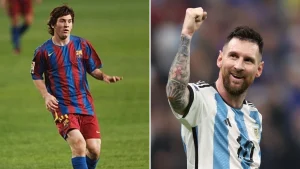
As his career progressed from Barcelona to Paris Saint-Germain and later Inter Miami, Messi’s role evolved. He moved from being a primary finisher to becoming the creative centre of the attack. This transformation has redefined the modern forward, proving that elite attackers can control games through vision, passing, and tactical intelligence, not just goals.
From Natural Goalscorer to Creative Leader
In his early Barcelona years, Lionel Messi’s main threat came from direct attacking actions. His dribbling, acceleration, and finishing made him a constant danger near the penalty area. He operated close to goal, often starting from wide positions and cutting inside to score.
Over time, tactical demands and physical changes influenced how Messi played. Managers encouraged him to drop deeper, collect the ball earlier, and connect midfield with attack. This adjustment allowed him to influence matches more frequently, rather than waiting for isolated scoring chances.
By receiving the ball between midfield and defense, Messi became the player through whom most attacks flowed. He began controlling tempo, choosing when to slow play and when to accelerate it. This marked a clear shift from a pure goalscorer to a creative leader responsible for shaping the entire attacking phase.

The Numbers Behind Messi’s Playmaking Evolution
While Lionel Messi’s goal statistics are widely known, his creative output is equally remarkable. Over his career, he has recorded more than 400 assists across club and international football, placing him among the most productive playmakers in history.
On average, Messi delivers between two and three key passes per match, consistently creating clear scoring opportunities for teammates. His passing volume remains high, with around 47 passes per game, reflecting how involved he is in build-up play and attacking transitions.
Advanced metrics such as expected assists highlight the quality of his passing rather than just the final outcome. These figures show that Messi does not rely on low-risk distribution. Instead, he attempts progressive and defense-splitting passes that directly lead to high-value chances.
Read More

These numbers confirm that his creative role is not secondary to his scoring. It is a core part of his influence on matches.
Vision, Awareness, and Spatial Intelligence
What separates Messi from many creative players is how quickly he processes information. His vision allows him to identify passing lanes before they fully open. His awareness of teammates’ movement helps him release the ball at precisely the right moment.
Messi’s low center of gravity and close control make it difficult for opponents to dispossess him, even when pressed by multiple defenders. This ability buys him time to scan the pitch and choose the most effective option.
His passing range includes short combinations, through balls behind defensive lines, and switches of play that change the point of attack. Each pass is calculated to disrupt defensive shape rather than simply maintain possession. This intelligent use of space has made him a tactical reference point for modern attacking football.
Redefining the Role of the Forward
Traditionally, forwards were judged primarily on goals. Creative responsibility belonged to midfielders, while attackers focused on finishing moves. Messi challenged this separation.
By combining elite scoring with consistent chance creation, he blurred positional boundaries. He operated as a forward, a playmaker, and sometimes even a deep creator within the same match. This flexibility forced opponents to rethink defensive structures and pressing strategies.

His success demonstrated that forwards could be the main creative force without sacrificing goal output. As a result, modern football increasingly values attackers who can both score and create, a shift directly influenced by Messi’s career model.
Influence Across Clubs and Leagues
Messi’s playmaking evolution has remained consistent across different environments. At Barcelona, he functioned as the central creative engine within a possession-based system. At Paris Saint-Germain, he adapted to a different tactical setup, sharing creative duties while still leading in chance creation.
At Inter Miami, even in the later stages of his career, Messi continues to balance scoring with playmaking. His vision and decision-making remain sharp, allowing him to dominate matches through intelligence rather than physical intensity.
This adaptability proves that his creative qualities are not system-dependent. They are rooted in football intelligence, technique, and experience, making his influence effective across leagues and playing styles.
Tactical Impact on Modern Football
Messi’s transformation has influenced coaching philosophy and player development. Youth academies now place greater emphasis on attackers learning passing angles, spatial awareness, and decision-making, not just finishing.
Coaches increasingly design systems where forwards drop into midfield spaces to overload central areas, a tactical concept popularized through Messi’s role. Defensive teams have also adapted, often assigning multiple players to block passing lanes rather than simply marking him tightly.
His career has shown that controlling games through creativity can be just as decisive as physical dominance, shaping modern tactical thinking.
Messi’s Legacy Beyond Statistics
Lionel Messi’s legacy extends beyond trophies and records. His evolution into a complete playmaker has reshaped expectations of attacking players at the highest level.
He proved that longevity at the top requires adaptation. By adjusting his role, Messi maintained influence even as physical attributes changed. His intelligence ensured that his impact remained constant across different phases of his career.
In doing so, Messi did not just succeed within modern football. He actively helped redefine it.
Lionel Messi’s journey from a prolific goalscorer to one of football’s greatest playmakers represents a fundamental shift in how the forward role is understood. Through vision, passing, and tactical intelligence, he expanded the responsibilities of attackers beyond scoring alone.
His ability to dominate games through creativity has influenced tactics, player development, and evaluation standards across the sport. Messi’s legacy is not only about how many goals he scored, but about how he changed what greatness looks like in modern football.
Also Read- Filipe Luís Signs New Flamengo Contract: Club Confirms Long-Term Deal Until 2027