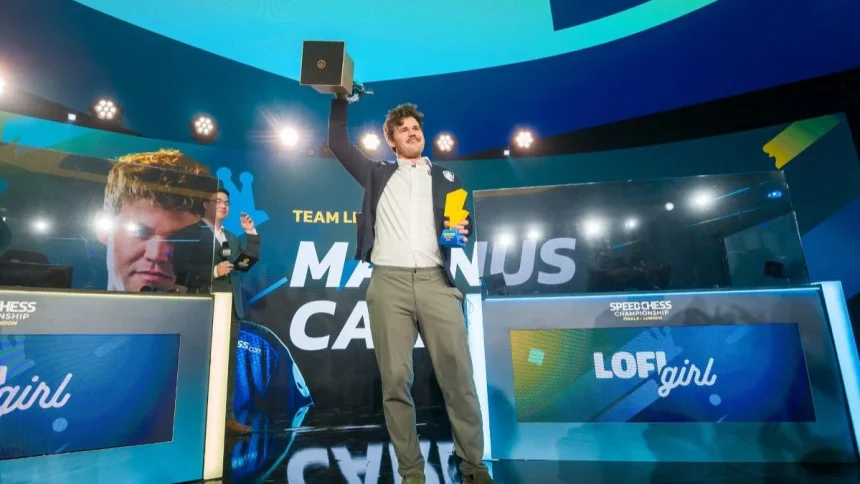
Magnus Carlsen secured his fifth Speed Chess Championship title on Sunday, defeating Alireza Firouzja 15–12 in a hard-fought final staged before a live audience in London. The victory marked Carlsen’s third consecutive triumph in the event and reinforced his enduring dominance in elite speed chess.
The London finals represented only the second time the concluding stages of the largely online championship were played live, following last year’s debut in Paris. On both occasions, the title match paired Carlsen with Firouzja, though this year’s encounter proved far more competitive than the one-sided Paris final, which Carlsen won 23½–7½.
The Speed Chess Championship, organised by Chess.com, has now been held ten times, and remarkably only two players have ever lifted the trophy: Carlsen and Hikaru Nakamura, who are now tied on five titles each. The format- combining 5-minute, 3-minute, and 1-minute games- has played a central role in professionalising online speed chess, long popular among amateur players but increasingly prestigious at the top level.
Magnus Carlsen’s Triumph
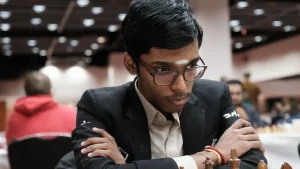
Firouzja entered the final after a gruelling semifinal victory over Nakamura and began confidently. In the opening 90-minute 5+1 segment, the French-Iranian won games five and six to briefly take the lead. Carlsen responded emphatically, reeling off three consecutive wins to seize control and close the segment with a two-point advantage.
The second phase, played at 3+1, was evenly balanced. Each player scored two wins, with the remaining games drawn, resulting in a 4½–4½ split that preserved Carlsen’s narrow lead heading into the decisive bullet portion.
Read More

Firouzja, thirteen years Carlsen’s junior, had already demonstrated his resilience earlier in the event by overturning a similar deficit in the bullet phase against Nakamura. Starting the final 1+1 segment two points behind, his chances of a comeback remained realistic.
Carlsen, however, moved quickly to shut the door. He won the opening bullet game to extend his lead to three points. From there, the match stabilised: the players traded wins with the black pieces, added several draws, and neither could generate a decisive late surge. The contest concluded with Carlsen prevailing 15–12.
A New Trophy and a Historic Link
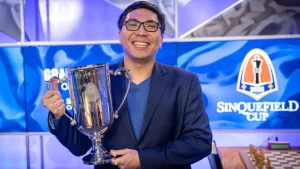
This year’s championship also introduced the Daniel Naroditsky Cup, named in honour of the late American grandmaster and beloved speed chess figure. The trophy will permanently display the names of all past champions, added retroactively, with future winners engraved as the event continues — a symbolic bridge between the championship’s history and its future.
Also Read: Esports World Cup 2026 Chess: Prize Money
Lazavik Stuns Nakamura for Third Place
Earlier in the day, the consolation match produced a surprise result, as 19-year-old Denis Lazavik defeated Nakamura 13½–12½ to claim third place.
Nakamura took an early lead by winning the 5+1 segment 4½–3½, but Lazavik delivered a dominant performance in the 3+1 phase, winning it 6–3 to overturn the deficit and establish a two-point cushion.
The bullet segment proved tense. After two opening draws, Lazavik extended his lead with a win, before Nakamura mounted a late comeback, scoring two wins and three draws over the next five games. That run left Nakamura with practical chances of levelling the match in the final encounter.
However, with the segment time expiring mid-game, championship regulations dictated that the game still counted toward the final score. In an approximately equal position, Nakamura allowed a perpetual check- later acknowledging he had misunderstood the rule- thereby confirming Lazavik’s victory.
“He’s a very strong opponent, so I’m very happy to win,” Lazavik said afterwards.