
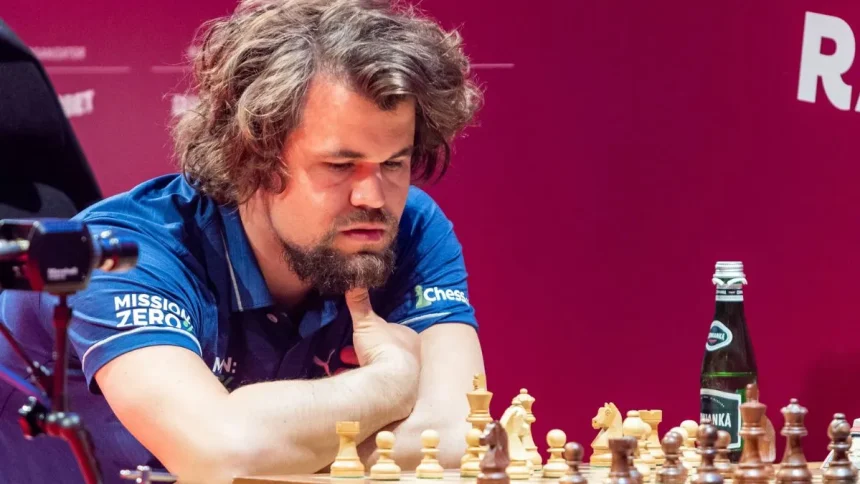
A seismic tremor rippled through the chess world when Magnus Carlsen clinched the inaugural FIDE Freestyle Chess World Championship in Weissenhaus, Germany. More than just another title on his remarkable résumé, this victory underscores a turning point in how elite chess intersects with innovation, embracing Chess 960 and hybrid formats that challenge convention and imagination alike.
Chess’s New Frontier: What Is the FIDE Freestyle Chess World Championship?
The 2026 FIDE Freestyle Chess World Championship was historic not just because Magnus Carlsen won it, but because it marked the first time FIDE (the International Chess Federation) officially sanctioned a world title in what’s commonly known as “freestyle”, essentially Chess960 or Fischer Random Chess with randomized starting positions.
In a format designed to diminish rote opening preparation and emphasize pure chess intellect, eight elite grandmasters competed over rapid and classical-like time controls, culminating in a best-of-four final between Carlsen and Fabiano Caruana.
Chess960 shakes the foundations of the classical paradigm by randomly positioning the back-rank pieces, creating 960 legal starting positions. This variation effectively neutralizes deep opening theory and returns the focus to over-the-board ingenuity and positional understanding. For decades, Fischer Random advocates have argued this is chess distilled to its essence; Carlsen’s triumph in this first official championship now gives that argument fresh legitimacy.
Carlsen’s Path to Freestyle Glory: A Different Kind of Mastery
Magnus Carlsen’s victory was far from a foregone conclusion. Facing Fabiano Caruana, a player known for precision and preparation, Carlsen found himself clinging to survival before staging a psychological and tactical shift, flipping a seemingly lost third game into a win and sealing the match with a draw in the fourth. That tactical poise under pressure exemplifies why Carlsen remains chess’s supreme generalist, able to adapt his classical strengths into the freestyle arena.
Read More
Importantly, this title represents Carlsen’s 21st world title across formats from classical to rapid and blitz and now including Chess960. That breadth highlights his adaptability and vision in embracing a world of chess that stretches beyond traditional boundaries.
Why the Carlsen Win Matters: A Catalyst for Chess Evolution
Magnus Carlsen’s triumph is more than a personal milestone; it signals a broader shift in the chess ecosystem. First, it legitimizes Chess960 at the highest competitive levels. For decades, purists resisted variants outside traditional 1.e4 openings and theory-heavy preparation. With FIDE’s endorsement and Carlsen, the world’s most visible chess figure, as its champion, Freestyle/Chess960 now sits squarely in the mainstream conversation.
Second, the win bolsters hybrid formats that blend classical strategy with modern engagement. Chess960’s unpredictable opening phase creates dynamic games that are harder to prepare for but easier for audiences to appreciate for sheer creativity. In an age where online platforms and rapid-paced events vie for attention, this unpredictability is a valuable asset for chess viewership and growth.
Read More
Hybrid Formats Gain Momentum: Beyond the Board
The implications of Carlsen’s victory extend into hybrid and spectator-friendly chess. Freestyle and Chess960 encourage formats where players rely on real-time decision-making over rote memorization, a quality that resonates in online tournaments, blitz events, and broadcast-friendly spectacles. They offer a bridge between classical depth and the dynamic entertainment values that younger audiences increasingly seek.
Moreover, Carlsen’s willingness to embrace these formats after stepping back from defending the classical World Championship, suggests that the future of elite chess might not revolve solely around centuries-old structures. Instead, it might thrive in a multi-format ecosystem that gives equal weight to creativity, speed, and adaptability.
Carlsen’s Influence on Chess Culture and the Next Generation
The ripple effects of Magnus Carlsen’s win will be felt in chess academies, youth programs, and global tournaments alike. Many young players gravitate toward classical opening theory as the entry point to chess mastery. But Chess960 rewards a different skill set: positional sense, pattern recognition independent of memorized lines, and imaginative calculation from the very first move. Carlsen’s championship puts a spotlight on these attributes, inspiring coaches and competitors to rethink training priorities.
In competitive circuits, this may translate into hybrid event calendars that include more Freestyle or variation-based formats alongside classical and rapid. Organizers and federations will likely take note; Carlsen’s name attached to a new world title naturally draws attention, sponsorships, and investment.
A Turning Point, Not an Endpoint
Although today’s chess tradition still holds classical formats at its core, Magnus Carlsen’s 2026 FIDE Freestyle Chess World Championship win underscores a future where alternative and hybrid formats are part of the global chess narrative. Carlsen’s victory, both symbolic and substantive, accelerates that evolution, giving Chess960 and hybrid competitions a platform that just a year ago seemed aspirational.
Also Read: Top 6 Chess Players To Look For In 2026