
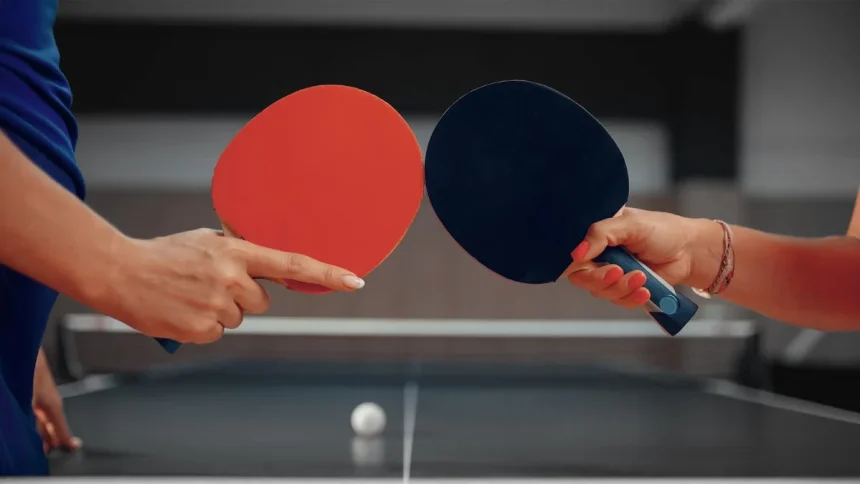
Ping-pong pops up everywhere in China, squeezed into tiny homes, schools, workplaces, and parks so folks young and old swing rackets just for fun or serious matches. Locals call it pīngpāng qiú, a down-to-earth term that stuck after government backing took off around the 1950’s,
You’ll spot home-made bats and public tables, whether out in villages or downtown blocks. City scenes often show kids training at school, employees playing between shifts, seniors gathering outdoors to rally and chat, turning rallies into shared moments across generations, not only games.
How Ping‑Pong Is Played Today
At its heart, ping-pong is a quick back-and-forth game where players hit a light ball across the net; each side allows one bounce before returning it. Matches often go up to 11 points, while winners are determined through an uneven number of sets. The gap between relaxed games and high-level skill lies in spin control, accurate placement, and split-second reactions, which serve to hide their spin type.
Replies aim to cancel it out, whereas exchanges turn into strategic battles, favoring swift movement and foresight. Backyard versions still stick to fundamental rules like proper serve tosses, correct court bounces, and taking turns hitting, making the sport work equally well for leisure or top-tier competition.
Rules That Turn Play into Sport
Ping-pong seems basic, yet strategy runs deep beneath. Games go to 11 points and serve switches every second point, but if tied, you need a two-point lead. Instead of tossing flat, the ball must rise straight up when serving.
Read More

Hit it so it lands on your half before crossing over, or lose the point outright. Because standards stay consistent, beginners and pros play under one system, which helps matches grow smoothly from backyard rallies to world titles.
How Technique and Equipment Reshaped Strategy
Minor tweaks in equipment caused major differences in gameplay. Switching from solid balls to celluloid, then plastic ones, along with using rubber-coated rackets and adding sponge padding, boosted spin and pace, pushing athletes to refine their serves, replies, and movement.
Among top competitors, games hinge on rotation, precision, and split-second coordination: a well-hidden serve might earn an instant point, whereas fast exchanges demand sharp instincts and tiny wrist adjustments. Such tech advances transformed a casual activity into one where thousands of seconds and fractions of inches make the difference.

The Global Competitive Landscape
Internationally, ping‑pong is tightly organized and fiercely competitive. The sport’s governing bodies maintain world rankings and a packed calendar of world tour events, team championships, and youth circuits that funnel talent upward.
While many countries produce strong players, recent decades have seen Asian nations, especially China, Japan, and South Korea, dominate top rankings and major medals, reflecting deep national systems and professional leagues.
From Parlour Play to Global Sport
Ping-pong started in Victorian England as a quiet indoor pastime; soon after, makers and groups set fixed gear and guidelines, shifting it from casual play to a structured game. New materials like celluloid spheres, rubber-coated rackets, and sponge inserts changed pace and strategy over time.
Global organizations stepped in, adding official contests and rankings throughout the 1900s, raising their competitive level gradually. When it entered the Olympics and gained wide coverage, the sport was already balanced between simple fun and serious expertise.
China’s Cultural Embrace and Everyday Play
In China, ping-pong fits easily into everyday routines since it doesn’t cost much and needs little room. You’ll find tables at schools, workplaces, local halls, or green spaces, while temporary spots pop up often in villages, helping the sport reach all kinds of people. To countless individuals, this game marks early years yet stays enjoyable through life: kids pick up simple moves during class, grown-ups hit balls to stay active and connect, older players gather for friendly matches each dawn. Such widespread presence built a wide pool where strong players can eventually be spotted and supported.
ALSO READ: Beyond The Numbers: The Journey And Mindset Of Salil Arora