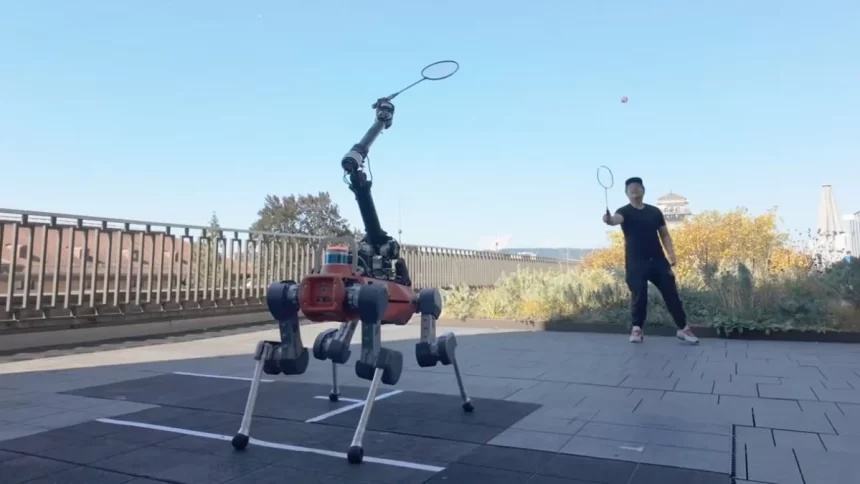
Badminton is no longer limited to human beings. Now, even robots are trying their hands at smashing shuttlecocks.
With Artificial Intelligence taking leaps and bounds, a robot-dog is now rallying with human opponents.
How A Robot Was Trained To Play Badminton
ANYmal, a four-legged dog, has been trained to play rallies up to 10 shots. A neural network was established to manage 18 joints, four legs and the racket arm.
Weighing around 50 kilograms and standing half a metre tall, the machine has stunned the audience with his forehand abilities. With a robotic arm and racket attached, it reached 1.6 metres in height.
The robot has learned to track the shuttlecock and return it successfully. The robot was rewarded for racket position, swing angle, speed, and movement efficiency. ANYmal adapted its movement based on distance and timing. At short distances, it stayed still, while longer shots forced it to sprint across the court. These strict rules helped it develop a playing style similar to humans.
Read More
The team led by Professor Marco Hutter of ETH Zurich’s Robotic Systems Lab built a simulation of a badminton court and ran 50 million trial sessions.
ANYmal is equipped with two cameras that allow it to follow the shuttlecock in flight. Using AI-driven prediction models, the robot can anticipate the trajectory of the shuttle and position itself accordingly.
Read More
This was made possible by a a sophisticated control system that integrates leg coordination, racket strokes, and visual tracking.
After training, the neural network was transferred to the actual robot. ANYmal faced shuttlecocks served by a machine at different speeds and angles. The robot learnt to scuttle, scramble, and even gallop to return shots. Swing speeds reached 12 metres per second, about half that of an amateur human player.
Also Read: Top 6 Best Badminton Rackets In The World
Beyond Badminton Court
The objective of the developing the robot was not just to make them play on a badminton court but also build a system that could enhance robot agility which could be used in disaster response, industrial assistance, and search-and-rescue operations.
“This is not just about sport,” said researcher Yuntao Ma, who led the work. “It shows how a robot can coordinate complex movements with vision in real time.”