

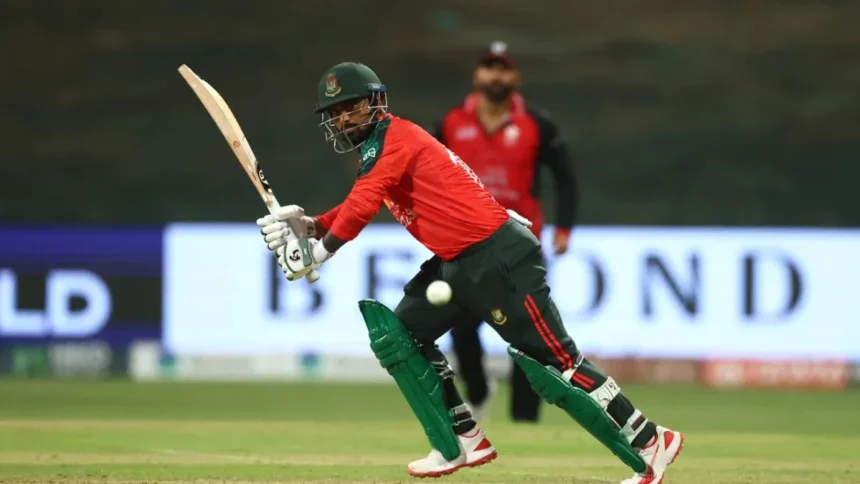
Why Are Sri Lanka And Bangladesh So Poor At T20I Batting? Sri Lanka and Bangladesh have both suffered from long-standing problems with their T20I batting, failing to produce competitive run rates against other leading international sides. In spite of numerous attempts to address the issue, the two teams have always figured near the bottom of the run rate table in men’s T20Is over the last decade.
Why Are Sri Lanka And Bangladesh So Poor At T20I Batting?: A Decade of Low Run Rates
Since more than a decade, Sri Lanka and Bangladesh have perpetually recorded the worst run rates in international T20 cricket, particularly since 2015. Out of the top ten-ranked T20I teams, these two countries have remained at the bottom two ranks for run rates.
2015-2019: Bangladesh (8th) and Sri Lanka (10th).
2020-2024: Sri Lanka (8th) and Bangladesh (10th).
2024 and beyond: Sri Lanka (8th) and Bangladesh (9th), just in front of Afghanistan.
Read More


This is essential due to the fluctuating nature of T20 cricket, where scoring at a better rate and aggressive batting have become the measures of winning. Despite these two countries switching players, coaches, and approaches, they have not been able to escape the drag.
Long-Term Batting Weakness: Suffering Through All Stages
Both Bangladesh and Sri Lanka have struggled through various stages of the match the powerplay, the middle overs, and death overs. But from 2024 onwards, there have been small strides:
Sri Lanka has improved in the powerplay and now stands 6th among the top 10 sides.
Read More

Bangladesh has picked up in the death overs and stands 5th.
Even with these changes, both units are still ineffective in the middle overs and continue to perform poorly in general compared to other leading teams.
The Role of Pitches: Blame Home Conditions?
One of the theories that has picked up steam in both Sri Lanka and Bangladesh is that the spin-friendly pitches in their homeland especially at Premadasa in Sri Lanka and Mirpur in Bangladesh do not permit their batters to establish the aggressive stroke play required in contemporary T20 cricket. These turning, slower pitches tend to suit spin bowlers, making it more difficult for the batters to score runs at quick rates.
Sri Lanka: Captain Wanindu Hasaranga has publicly decried the slower Premadasa tracks that foil aggressive batting.
Bangladesh: The players have preferred playing at Sylhet, which has more favorable batting conditions than Mirpur. Even former Pakistan coach Mike Hesson decried the Mirpur pitch as “not up to international standards” following a low-scoring 2024 match.
The statistics appear to uphold this hypothesis. Matches played in Sri Lanka and Bangladesh since 2020 have had the lowest run rates as well as batting averages compared to other nations.

Benchmarks:
Sri Lanka’s home average run rate: Ninth among the top 10 teams.
Bangladesh’s home average run rate: Tenth among the top 10 teams.
How Do They Play Away from Home?
A telling indicator of the impact of home conditions is how Sri Lanka and Bangladesh perform when playing away from home. Both teams generally see a noticeable improvement in their batting scores outside their home countries.
Sri Lanka: Average 5.6 more runs per innings when playing away from home.
Bangladesh: Average 14 more runs per innings when playing abroad.
In comparison to the other high ranking teams who average 30.6 runs per innings based upon away performance outside Sri Lanka and Bangladesh.
Away Performance Summary:
Sri Lanka performance away: an extra 5.6 runs per innings compared to home.
Bangladesh performance away: an extra 14 runs per innings away from home.
This large gap confirms that the conditions in Bangladesh and Sri Lanka are indeed being responsible for their regular run rate problems.
The Challenges Ahead: Enhancing Batting in Home Conditions
In the years to come, Sri Lanka and Bangladesh have significant challenges to tackle in light of the increasing popularity of T20 cricket. Sri Lanka co-hosts the 2024 T20 World Cup, and the Premadasa ground is expected to stage most of the games. This brings opportunities as well as challenges for these teams since they need to modify their game to suit local conditions more effectively while ensuring consistency at international grounds.
Also, the UAE, where several international tournaments such as the Asia Cup are hosted, is famed for laying low-scoring pitches like Sri Lanka and Bangladesh. The two sides can get more at ease in that kind of environment, which can benefit their performance.
But India, which boasts high-scoring tracks, will stage most of the World Cup matches. It is a problem for both Sri Lanka and Bangladesh because their batsmen will have to acclimatize to quicker, more high-scoring tracks if they are going to be able to match the others at the top.
Key Points to Address:
Improvement in aggressive stroke play: Both teams must adapt their T20 batting style to fit modern cricket. Adaptations to different pitch conditions: The ability to master playing on faster, bouncier pitches (for example Indian pitches) will be essential for success at the T20 World Cup.
A Long-Term Issue That Demands Instant Action
The ongoing problem of low run rates in Sri Lanka and Bangladesh is complicated; however, the home pitches are part of the problem. The emphasis on making pitches that favor spin has prevented both teams from getting bedded down to play the aggressive top-order batting that is necessary to score big runs in T20 cricket.
There have been improvements in certain areas of the game, yet they both have not necessarily improved upon the overall consistency, especially throughout the middle overs.
Sri Lanka and Bangladesh need to address these problems, but also need to continue to develop their game for home and away conditions. As the next T20 World Cup is on the horizon, they need to focus on their batting weaknesses and their batsmen’s ability to score the runs quickly and consistently regardless of the pitch.
ALSO READ: England Smashes 300+ Runs For The First Time In T20I Cricket