



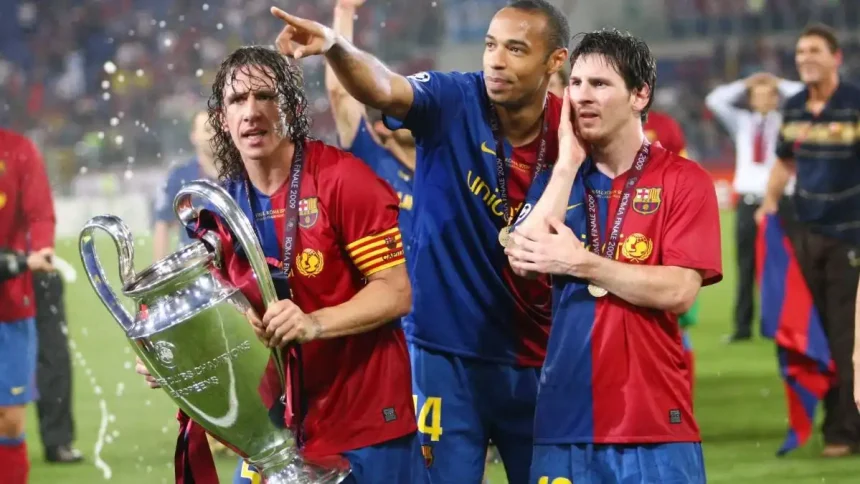
The magic of the UEFA Champions League lies in its history, prestige, and the elite clubs that have defined European football across generations. From dominant dynasties to modern tactical powerhouses, the UEFA Champions League has consistently showcased the highest level of club competition, producing iconic winners and unforgettable moments.
- 1. Real Madrid’s Untouchable UEFA Champions League Legacy
- 2. AC Milan: Italy’s UEFA Champions League Powerhouse
- 3. Liverpool and Bayern Munich: European Giants with Six Titles
- 4. Barcelona’s Golden Era in the UEFA Champions League
- 5. Ajax and the Rise of Tactical Innovation
- The Three-Time Winners Club
- Clubs with Two Titles: Depth of UEFA Champions League Competition
- One-Time Winners and Modern Breakthroughs
- UEFA Champions League Success by Nations
- How the UEFA Champions League Has Evolved
1. Real Madrid’s Untouchable UEFA Champions League Legacy
No discussion about the UEFA Champions League begins without Real Madrid. The Spanish giants stand alone with a record 15 titles, making them the most successful club in the competition’s history.
Their dominance started in the inaugural editions, winning five consecutive European Cups from 1956 to 1960, a feat that remains unmatched.
In the modern era, Real Madrid reinvented themselves again, winning multiple titles between 2014 and 2018 and adding another in 2024. This sustained excellence across eras defines their superiority in the UEFA Champions League.
2. AC Milan: Italy’s UEFA Champions League Powerhouse
Second on the all-time list is AC Milan, with 7 titles.
Read More

The Rossoneri built their European legacy across different tactical periods, from defensive solidity in the 1960s to the dominant Arrigo Sacchi and Carlo Ancelotti eras. Their last triumph came in 2007, but their consistency in reaching finals keeps them among the elite names in UEFA Champions League history.
3. Liverpool and Bayern Munich: European Giants with Six Titles
Both Liverpool and Bayern Munich have lifted the trophy six times each, cementing their place among the most successful clubs in the UEFA Champions League.
Liverpool’s European identity is deeply rooted in dramatic comebacks and iconic nights, including the famous 2005 final in Istanbul. Bayern Munich, on the other hand, represent German efficiency and dominance, with success spread across multiple decades, including their 2020 triumph.

4. Barcelona’s Golden Era in the UEFA Champions League
With five titles, Barcelona have been one of the defining teams of the modern UEFA Champions League era.
Their dominance peaked between 2006 and 2015, driven by a possession-based philosophy that redefined European football. Under managers like Pep Guardiola, Barcelona combined tactical innovation with generational talent to dominate the UEFA Champions League landscape.
5. Ajax and the Rise of Tactical Innovation
Ajax sit just below with four titles and are historically significant in shaping the tactical identity of the UEFA Champions League.
Their success in the 1970s introduced “Total Football,” a revolutionary approach that influenced generations of teams. Though their last win came in 1995, Ajax remain one of the most respected clubs in European competition history.
The Three-Time Winners Club
Several elite clubs have won the UEFA Champions League three times, including Inter Milan and Manchester United.
These clubs have had distinct golden periods. Inter’s treble-winning season in 2010 stands out, while Manchester United’s victories under Sir Alex Ferguson define English success in Europe.

Clubs with Two Titles: Depth of UEFA Champions League Competition
A group of clubs have won the UEFA Champions League twice, highlighting the competition’s depth. This list includes Chelsea, Juventus, Benfica, Porto, and Nottingham Forest.
These teams may not dominate the all-time charts, but their triumphs underline how competitive and unpredictable the UEFA Champions League can be.
One-Time Winners and Modern Breakthroughs
The UEFA Champions League has also seen several clubs win the title once, including Manchester City and Paris Saint-Germain, who secured their maiden titles in recent years.
These victories reflect the evolving financial and tactical landscape of European football, where new contenders are emerging alongside traditional giants.
UEFA Champions League Success by Nations
Spanish clubs dominate the UEFA Champions League, largely due to Real Madrid and Barcelona, with the highest combined titles. England, Italy, and Germany follow closely, showcasing the traditional power centers of European football.
This distribution highlights how certain leagues have historically produced the strongest teams in the competition.
How the UEFA Champions League Has Evolved
Originally launched as the European Cup in 1955, the competition evolved into the UEFA Champions League in 1992, introducing group stages and expanding participation.
Today, it features a broader format and global appeal, making it the pinnacle of club football. Despite these changes, the core objective remains the same: crowning the best team in Europe.
Also Read: NYCFC vs Inter Miami: Match Preview, Prediction, Lineups And How To Watch Free