
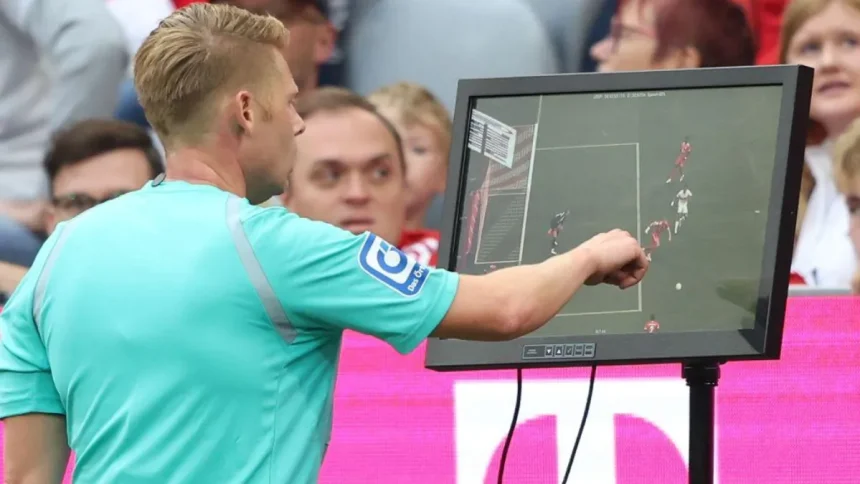
Across Europe’s biggest football stages, VAR has become the sport’s most polarizing companion. Fans, players, managers and pundits all agree on one point: VAR was introduced to make the game fairer. Yet, paradoxically, discussions about fairness, consistency and trust swirl louder now than ever before. From the Premier League to La Liga and the Champions League, the technology that was meant to clarify refereeing decisions is at the heart of ongoing debates and not just about outcomes, but about the confidence fans and stakeholders place in the officials tasked with using it.
Why VAR was Supposed to Be Europe’s Refereeing Fix
When VAR arrived in professional football, the message was simple: eradicate clear and obvious human errors that influence match-deciding moments. Leagues across Europe embraced the system believing it would modernize refereeing and reinforce trust in officiating. In UEFA competitions alone, hundreds of matches each season now use VAR, and governing bodies have run courses to align referees and video assistant referees on key procedures like offside and high challenges.
In theory, VAR should help referees get more decisions right and remove controversy from critical moments. Clubs deploy it to ensure that goals, penalties and red cards are checked with the benefit of multiple camera angles and expert review. Yet the very technology designed to reduce error has instead highlighted football’s most stubborn officiating weakness consistency.
VAR’s Paradox: More Accuracy, Less Trust
Leagues proudly point to improved statistical accuracy since VAR’s introduction. In the English Premier League, for example, recent figures suggest that correct decisions have increased by a noticeable margin.
But beyond numbers, the narrative among supporters is that VAR has become part of the problem rather than the solution. Disagreement isn’t just about the output. It’s about why decisions happen the way they do. Are offside calls judged under the same threshold every time? Is handball still subjective after review? The optics, and the outcomes, are fueling scepticism. Watching teams drop points or win titles following controversial VAR interventions has, in some fan circles, eroded trust in refereeing altogether.

This distrust isn’t confined to supporters. Managers across elite leagues, from England to Spain routinely voice frustration at what they see as inconsistent VAR communication and decision thresholds. Some argue that VAR has turned refereeing into an exercise in nervousness, where officials hesitate to make on-field calls for fear they’ll be judged by a panel of off-field eyes.
The Human Element: Referees Caught Between Two Worlds
At the core of the controversy is the relationship between on-field referees and VAR officials. Modern referees now work in an environment where split-second calls are immediately replayed for millions to critique, often without the full context of law interpretations. Some former players and pundits argue that referees have become over-reliant on VAR instead of trusting their own judgment.
This is not a trivial point. Referees are trained to apply the Laws of the Game under immense pressure. VAR was never supposed to replace on-field authority. It was meant to intervene only for “clear and obvious” errors. Yet when the technology intervenes frequently, or appears to correct judgment calls rather than blatant mistakes, it can create confusion about the role of the referee and the threshold for intervention.

Consistency: A Bigger Issue Than Technology
If there’s a recurring theme across leagues and competitions, it’s this: inconsistency remains the biggest unresolved issue. Fans repeatedly highlight situations where one official follows a guideline strictly while another interprets similar events differently. Reddit forums, social commentary and even league reports emphasize viewers’ perception that officials apply different standards from game to game or even within the same match.
In Spain, disputes over VAR intervention criteria have intensified internal committee reviews and disciplinary scrutiny. In Italy, administrators warn against “microscopic” review tendencies that stray from VAR’s intended purpose of correcting only decisive errors.
These debates highlight a deeper reality: the problem is not VAR itself but the lack of universally understood and consistently applied officiating standards. Without this, even a perfect video review system cannot guarantee uniform outcomes that build shared trust.
Training, Transparency, and Restoring Confidence
Leagues and refereeing bodies are aware of the perception problem. UEFA and national leagues regularly invest in training, courses and alignment workshops to ensure officials, including VAR specialists, are on the same page. Transparency initiatives, like releasing audio explanations of VAR decisions, have also been proposed to connect fans to the reasoning behind critical calls.
Still, until teams, supporters and pundits can reliably predict how VAR will be applied, trust will lag behind technology adoption. VAR will remain central to debates about fairness, authority and credibility in European football’s officiating landscape, shaping conversations long after the final whistle.
Also Read: How Tactical Systems In Football Have Become More Important Than Individual Superstars