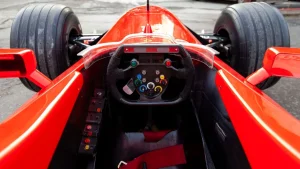


Communication between race officials and drivers is essential for both groups in a fast-paced sport such as Formula 1. So, the majority of communication between the driver and his team is done through radio, but there are also many important signals or flags that the drivers need to interpret and act on as directly as possible from the track marshals near their location.
In Formula 1 races, the flag system is an essential part of this communication between race officials and drivers.
Flag signals are used on all circuits all over the world to provide information on conditions, race incidents and warnings to the driver who is racing at a high speed and needs to respond without hesitating.
Each flag colour has an associated meaning, which means that every time a green, yellow, red or any other colour of flag is shown at that circuit, it has the same corresponding meaning for all drivers racing at that circuit.
Let’s just learn and know the basic meanings behind these flags.
Read More

Green Flag

The green flag signals that the track is clear and safe for racing.
It is usually shown at the start of practice sessions, qualifying sessions, or the formation lap before the race begins. It can also appear after a yellow flag situation to indicate that the danger has passed, and drivers can return to normal racing speed.
Red Flag
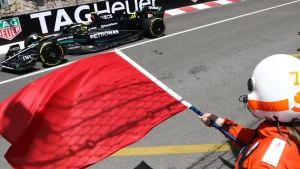
The red flag means the race or session has been stopped.
Read More

This is typically used when there is a serious accident, dangerous weather conditions, or track damage that makes it unsafe to continue. When a red flag is shown, drivers must slow down and follow instructions from race officials.
During practice or qualifying, drivers return to their garages. In a race, they usually proceed to the pit lane and wait for further instructions until the session resumes.
Yellow Flag
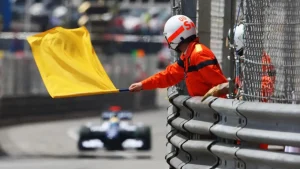
The yellow flag warns drivers about danger ahead on the track.
There are two types of yellow flag signals:
Single yellow flag:
Drivers must slow down, avoid overtaking, and be prepared to change direction because there may be a hazard near the track.
Double yellow flag:
This indicates a more serious situation. Drivers must reduce speed significantly and be ready to stop if necessary. This is usually shown when a car is blocking part of the track or when marshals are working near the circuit.

During practice and qualifying sessions, drivers must also abandon their fast lap if they encounter a yellow flag.
Yellow and Red Striped Flag

A yellow flag with red stripes warns drivers that the track surface has become slippery.
This could be caused by oil, water, debris, or other substances on the track. Drivers must be cautious because grip levels may be lower than usual.
White Flag

The white flag tells drivers that there is a slow-moving vehicle ahead.
This could be a car with mechanical problems, a service vehicle, or another driver moving slowly on the track. Drivers must stay alert and prepare to approach the slower vehicle safely.
Blue Flag
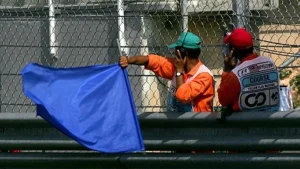
The blue flag is used to manage traffic between faster and slower cars.
During practice or qualifying, it warns a driver that a faster car is approaching from behind and is about to overtake.
During a race, it is shown to drivers who are about to be lapped by a leading car. When this happens, the slower driver must allow the faster car to pass as soon as possible. Ignoring repeated blue flags can result in a penalty.
The blue flag may also be shown when a driver exits the pit lane and another car is approaching on the track.
Black Flag

The black flag is one of the most serious signals in Formula 1.
It means a driver has been disqualified from the race and must return to the pits immediately. This decision is made by the race stewards and is rarely used, as it usually follows a serious rule violation.
Black Flag with Orange Circle
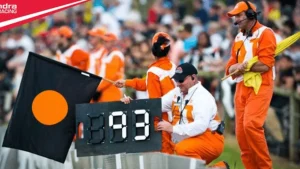
This flag indicates that a car has a mechanical problem that could be dangerous.
If a driver sees this flag along with their car number, they must return to the pits so the team can fix the issue. If the problem cannot be repaired, the car must retire from the race.
Black and White Flag

The black and white diagonal flag acts as a warning for unsporting behaviour.
It is shown to drivers who may have broken rules related to driving conduct. The flag is accompanied by the driver’s race number. If the behaviour continues, further penalties may follow.
Chequered Flag

The chequered flag marks the end of a session or race.
When drivers see this black-and-white patterned flag waved at the finish line, it means the race has officially ended. Drivers complete the lap they are on and return to the pit lane after crossing the line.
Modern Formula 1 circuits also use electronic light panels placed around the track. These panels display the same signals as traditional flags and help drivers see warnings clearly, especially during night races or in poor weather.
Also read: Formula 1 Global Fan Base and Records: 2026 Loading