



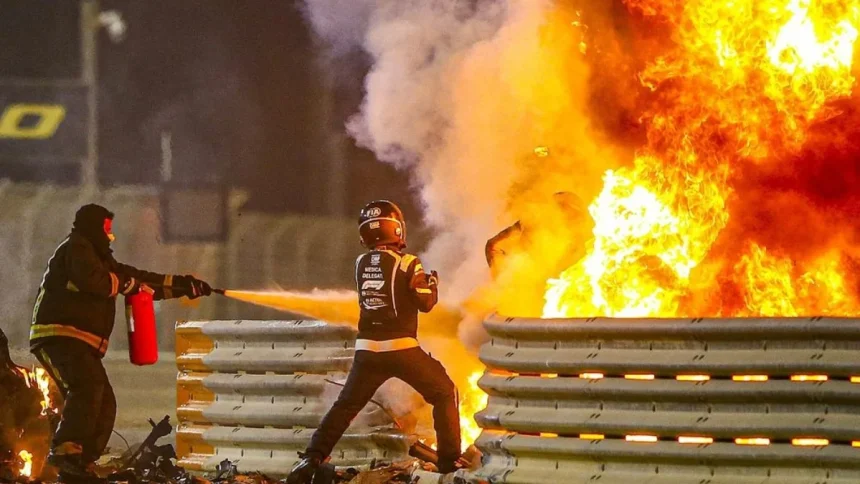
Accidents in Formula 1 have helped make racing safer for drivers. After serious crashes, new safety rules were introduced. The HANS device became mandatory in 2003 to protect the head and neck during impacts. In 2018, the Halo was added to stop flying debris from hitting drivers. Ayrton Senna’s 1994 crash led to safer track designs, Jules Bianchi’s 2014 accident brought the virtual safety car, and Romain Grosjean’s 2020 fire improved barriers and racing gloves.
- Jules Bianchi Crashand Safety Lessons from Accidents in Formula 1
- Romain Grosjean in Bahrain Grand Prix Crash-out and Accidents in Formula 1 Safety
- Ayrton Senna and Roland Ratzenberger Horrorific Accident of 1994
- Zhou Guanyu Crash Reshaped Accidents in Formula 1 Safety
- Fernando Alonso’s car flew over Leclerc’s Car
Jules Bianchi Crashand Safety Lessons from Accidents in Formula 1
Accidents in Formula 1 have often influenced how safety regulations are developed. In 2014, Jules Bianchi crashed into a recovery crane during wet conditions at the Japanese Grand Prix. The accident sadly became fatal and showed that better speed control was needed when marshals were on track. As a result, Formula 1 introduced the Virtual Safety Car system, which slows all cars uniformly and helps race officials manage incidents more safely in dangerous situations.
Romain Grosjean in Bahrain Grand Prix Crash-out and Accidents in Formula 1 Safety
Accidents in Formula 1 have helped improve driver safety over the years. In 2020, Romain Grosjean survived a massive 67G crash at the Bahrain Grand Prix when his car split in two and caught fire after hitting the barrier. He escaped with burns but survived because of strong safety systems. After this accident, Formula 1 upgraded fire-resistant suits and gloves, reviewed barrier designs, and improved cockpit protection to make racing safer for drivers.
Ayrton Senna and Roland Ratzenberger Horrorific Accident of 1994
Accidents in Formula 1 have played a big role in improving safety. In 1994, a tragic weekend at the Imola Grand Prix saw Ayrton Senna and Roland Ratzenberger lose their lives in separate crashes. The incidents shocked the racing world and forced Formula 1 to make major safety changes. Circuits were redesigned to reduce speed, cockpits were strengthened to protect drivers better, and crash tests became much stricter to make cars safer in future races.
Zhou Guanyu Crash Reshaped Accidents in Formula 1 Safety
Accidents in Formula 1 have helped make cars safer with new rules. In 2022, Zhou Guanyu was involved in a dramatic first-lap crash at the Silverstone Grand Prix when his car flipped upside down and slid across the track before stopping against the barriers. He survived without serious injury, showing how strong safety systems were. After this accident, Formula 1 strengthened roll hoop regulations for the 2023 season to better protect drivers in rollover crashes.
Read More

Fernando Alonso’s car flew over Leclerc’s Car
Accidents in Formula 1 have shown how important safety devices are for drivers. In 2018 at the Belgian Grand Prix in Spa, Fernando Alonso’s car flew over Charles Leclerc’s Sauber during a first-lap crash. The Halo device, introduced that same season, protected Leclerc’s head from serious impact. The incident proved that the Halo could prevent severe head injuries and helped teams and fans understand why this safety system became an important part of Formula 1 cars.
ALSO READ: Aston Martin Drops Major Australia Bombshell- What’s Next?