As the tennis season gets underway in its Asian Swing, searing temperatures and suffocating humidity have pushed players to the brink, with multiple retirements and alarming on-court incidents prompting renewed calls for the organisers to adopt a formal heat policy.
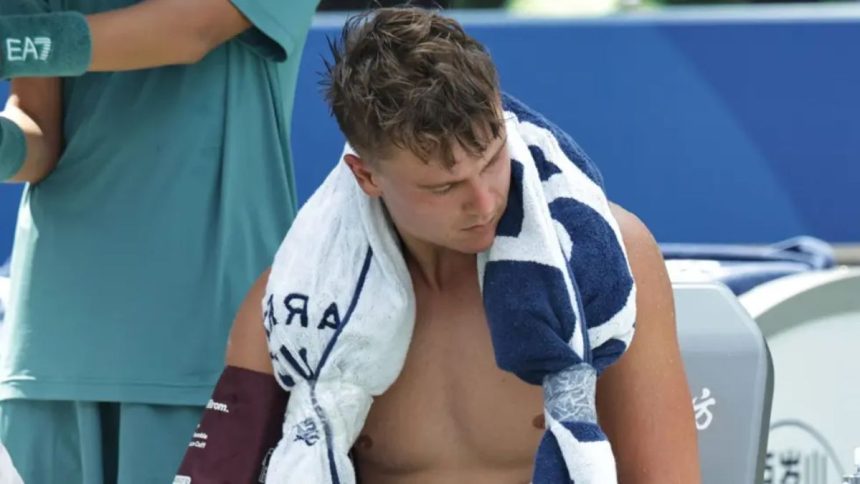
At the Shanghai Masters, where daytime temperatures reached 34°C with 80% humidity, several top players visibly struggled to cope. World No. 2 Jannik Sinner was forced to retire mid-match due to cramping so severe he could barely walk. Novak Djokovic, despite winning his third-round match, vomited courtside from the heat, calling the conditions “brutal.”
Meanwhile, Holger Rune, who required medical assistance and ice towels to continue, questioned officials: “Do we have to die on court?” Later, he stated, “Every player would agree [on the need for a heat rule]… We need to survive.”
The carnage in Shanghai follows similar scenes at the Wuhan Open, 500 miles away, where Emma Raducanu retired from her match due to dizziness, and Jelena Ostapenko revealed she had suffered a heat stroke. On the WTA tour, heat protocols are already in place, including 10-minute breaks and potential match suspensions- a stark contrast to the men’s tour.
Current ATP Rules: Vague and Inadequate
Currently, there is no formalized heat policy at ATP. Decisions to suspend play due to heat are left to the discretion of an on-site supervisor, who consults with medical staff and local authorities. There is no provision for breaks during men’s matches, unlike the WTA and Grand Slams, which have adopted heat index systems and structured response plans.

The Australian Open, for example, uses a Heat Stress Scale and suspends play when it reaches level five, while other Slams and the WTA offer extended breaks once thresholds are hit.
A Year of Warning Signs
The alarm bells aren’t new. In Cincinnati this August, Arthur Rinderknech collapsed during a match under intense heat and humidity, prompting concern across the tennis world. With similar events now repeating in Shanghai in China, the calls for reform are growing louder.
Terrence Atmane, who retired in his first-round match, later posted that he experienced violent shaking and difficulty breathing, stating: “The heat stress I’ve faced today could have been worse than losing consciousness.”

Even the usually stoic Djokovic said: “It’s brutal when you have over 80% humidity day after day, particularly during the daytime. It’s the same for everyone, but it takes a toll.”
ATP’s Response: Policy “Under Active Review”
In a statement, the ATP acknowledged the situation, saying:
“This remains under active review and additional measures, including the implementation of an official heat policy, are currently being evaluated in consultation with players, tournaments, and medical experts. Player safety remains a top priority for the ATP.”
However, critics argue that with player health at risk, review is no longer enough- action is urgently needed.
Also Read: China Open: Who Is The Most Successful Player? List Of Title Holders
Why Play in Such Heat?
The tennis calendar is structured to follow fair weather, with tournaments moving to Asia in October to avoid rain-prone regions like Europe and North America. But with limited indoor facilities and a packed schedule, outdoor tournaments in high heat zones have become unavoidable.

Still, as climate change continues to amplify extreme weather events, many believe that tournament logistics must evolve, or more players will suffer preventable injuries- or worse.