

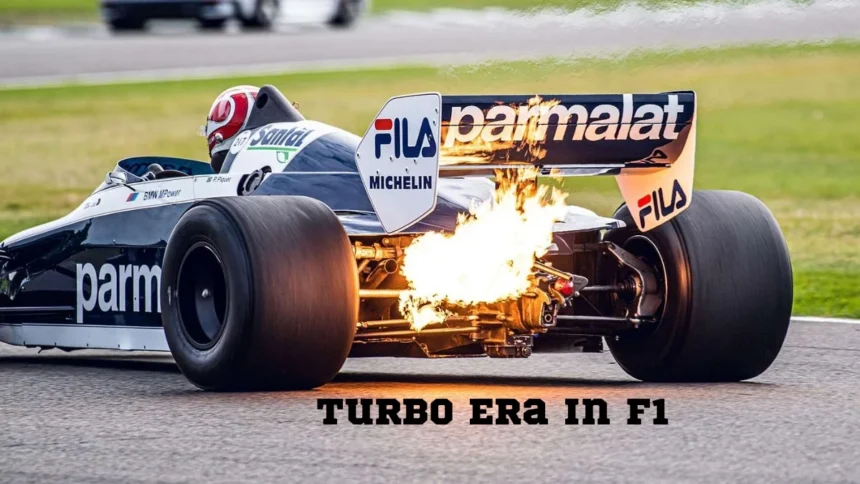
Have you even thought about what it would be like if they ran F1 cars on jet fuel? While it might be an intriguing topic to indulge in, it actually happened in the 1980s, Turbo Era in F1. This period marked the most extreme and innovative period in the sport’s history. During these years, F1 cars ran on a highly specialised fuel, often compared to jet fuel, and were powered by turbocharged engines that produced unimaginable levels of horsepower, pushing the limits of both technology and speed.
When Was the Turbo Era In F1 Introduced?
Turbocharged engines made their F1 debut with Renault in 1977. Initially, the technology was unreliable and even mocked in the paddock, but it quickly proved why it was there. By the early 1980s, these engines were dominating the grid, offering a more efficient way to extract performance from the car within the FIA’s guidelines. The breakthrough came when Nelson Piquet won the Driver’s Championship for Brabham-BMW with a turbocharged engine, marking the first championship for F1 cars on jet fuel.
The search for more power led teams to experiment with fuel chemistry. The regulations required that the fuel should be similar to road petrol, however, they were loosely worded. This allowed engineers to develop fuel with a high concentration of toluene, a hydrocarbon that increased the fuel’s resistance to detonation and enabled high boost pressure. These fuels were not exactly jet fuels, but their performance and characteristics earned them the nickname.
Why Were F1 Cars On Jet Fuel Introduced?
The Turbo Era in F1 was introduced in pursuit of speed and efficiency. Turbochargers allowed small 1.5-litre engines to produce massive power, especially when paired with exotic fuels. By 1986, qualifying engines were rumoured to produce up to 1,400-1,500 horsepower, with boost pressures exceeding 5 bar. These developments were made with the desire to exploit every loophole in the regulations to gain a competitive edge.
Why Was The Turbo Era In F1 Discontinued?
The turbo era in F1 quickly became unsustainable. The combination of extreme power and fragile engines led to reliability issues and safety concerns. Engines in qualifying trim sometimes lasted only a few laps, earning them the nickname “grenades” due to their tendency to fail. Additionally, the escalating cost and performance gap between teams made FIA intervene.

Eventually, regulatory changes were introduced by FIA with restrictions on Turbo boost (limited to 4 bars) and reduced fuel tank sizes to cut power and encourage efficiency. By 1988, the boost was further restricted to 1.5 bar and from 1989 onwards, the turbochargers were banned altogether. The use of exotic, jet fuel-like blends was also outlawed as the FIA tightened fuel regulations to ensure safety.
Turbo Era In F1: A Golden Age
The Turbo Era in F1 is often regarded as a golden age for its sheer audacity and innovation, despite or perhaps because of its excesses. It stands as a testament to what happens when engineering is given free rein and continues to inspire both nostalgia and respect across the racing world.
Also Read: A Six-Wheeled Car In F1? Here’s Everything You Need To Know About Tyrrell P34