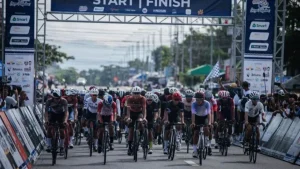
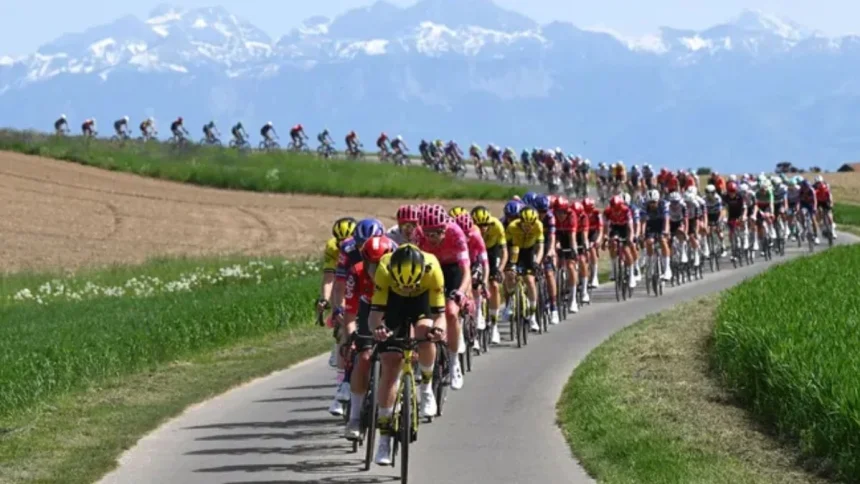
The Giro d’Italia is set to have the boldest routes in the race’s storied history in 2026 for its 109th edition. Unveiled in Rome at the Auditorium Parco della Musica Ennio Morricone, the upcoming Corsa Rosa stretches across borders, seas and some of Europe’s harshest mountains, weaving a narrative that blends innovation, heritage and raw physical challenge.
From May 8 to May 31, the peloton will cover 3,459 km with nearly 50,000 metres of vertical gain, battling through seven summit finishes, a single 40.2 km time trial, and a final showdown beneath the monuments of Rome. Outgoing race director Mauro Vegni, who retires in February after more than 30 years shaping the Giro, has created a route that feels both modern in rhythm and uncompromising in difficulty- a parting gift worthy of his legacy.
Bulgaria’s Grande Partenza: A New Frontier at Giro d’Italia 2026
For the 16th time, the Giro begins beyond Italian borders, breaking new ground in Bulgaria, a debut host of the Grande Partenza.
- Stage 1 rolls along the Black Sea from Nessebar to Burgas, offering sprinters the first Maglia Rosa of 2026.
- Stage 2, from Burgas to Veliko Tarnovo, immediately shakes the GC with a steep 3.5 km climb at 7.5% just before the finish.
- Stage 3, Plovdiv to Sofia, brings the sprinters back to the fore before the race enjoys a rare mid-week rest day to transfer to Italy.
Bulgarian Prime Minister Rosen Zhelyazkov hailed the opportunity as a cultural milestone, emphasizing the nation’s growing sporting ambition.
Week One: Italy Returns, and the Blockhaus Bites Early
The Giro re-enters Italy through Calabria, but tranquility doesn’t last long.

After a sprinter-friendly opener from Catanzaro to Cosenza, the difficulty curve ramps sharply:
- A rugged ride from Praia a Mare to Potenza introduces punishing gradients on the Montagna Grande di Viggiano.
- A nostalgic sprint finish awaits in Naples, but the calm breaks on Stage 7, a truly monstrous 246 km journey to Blockhaus- the first major summit finish, approached via the brutal Roccamorice ascent.
Veteran champion Vincenzo Nibali put it bluntly: “You won’t be able to hide.” If history repeats, this early test will crush a few dreams.
The week ends with a double sting: the Marche’s explosive “Muri” en route to Fermo and the return of Corno alle Scale, absent since Gilberto Simoni’s 2004 triumph.

Week Two: The Long Time Trial and the Alpine Punishment
A rest day leads into the race’s sole time trial, a 40.2 km drag from Viareggio to Mass- a throwback to the traditional long TT, and a crucial lifeline for specialists such as Evenepoel-type riders.
The midweek stages through Chiavari, Novi Ligure and Verbania provide varied opportunities, but the weekend delivers a violent whiplash of altitude:
- Stage 14 in the Aosta Valley packs a staggering 4,400 metres of elevation in just 133 km, with ascents of Saint-Barthélemy, Lin Noir and Verrogne before the decisive climb to Pila- its first appearance in more than 30 years.
This is a stage where contenders don’t just lose time- they can lose the Giro.
A high-speed sprint in Milan closes the week, marking the city’s 90th Giro stage finish.
Week Three: Switzerland, the Dolomites, and Judgment Day
The final week begins across the border in Switzerland, finishing atop Carì, a gruelling 11.6 km at 8.1%- short but explosive.
Two transition stages offer brief respite before the race enters its most feared terrain: the Dolomites.
Stage 19 – The Dolomite Queen Stage
From Feltre to Piani di Pezzè, riders must survive a succession of legends:
- Duran
- Staulanza (via Coi)
- Giau- this year’s Cima Coppi, topping out at 2,233 m
- Falzarego
Before the final climb to Piani di Pezzè, a summit last seen during Marco Pantani’s amateur-era victory in 1992.
It is a stage destined for drama, collapse and glory in equal measure.
Stage 20 – Piancavallo Twice
The penultimate day pays tribute to the 1976 Friuli earthquake, passing through the affected region before tackling back-to-back ascents of Piancavallo (14.5 km at 7.8%).
Here, the Giro’s winner will emerge- there is nowhere left to hide.
The race ends, for the fourth consecutive year, in the majesty of Rome, with a nine-lap circuit through the Eternal City offering one last chance for the sprinters.
A Giro Built for Tradition and Transformation
Mauro Vegni described his final route as “a more modern Giro”—shorter stages on average, but sharper, more decisive, and drenched in altitude. On paper, it strikes an old-school balance:
- one long time trial,
- a smattering of medium-mountain traps,
- and colossal high-mountain stages saved for when they matter most.
It is a course that tempts time trial specialists while demanding the resilience of pure climbers. It is a course shaped for spectacle.
And above all, it is a Giro with identity: unpredictable, beautiful, brutal.
Also Read: Saudi Arabia To Host Asian Road Cycling Championships 2026
Women’s Giro d’Italia: Nine Days, One Alpine Verdict
Running May 30–June 7, the Giro d’Italia Women adopts a new slot after the men’s race and delivers its own drama. Highlights include:
- A time-trial climb to Nevegal
- A Dolomitic Stage 5
- And a decisive Stage 8, featuring the gravelled Colle delle Finestre and finishing in Sestriere- nearly identical to the queen stage of the 2025 men’s Giro.
The organizers have made no secret of it: the Finestre will decide everything.
A Race Poised for Legends
From the Black Sea to the Dolomites, from Bulgaria’s welcoming roads to Rome’s ancient stones, the 2026 Giro d’Italia is a grand tour designed with intent. It is not the longest in history, nor the most experimental- but it may be among the most perfectly balanced.