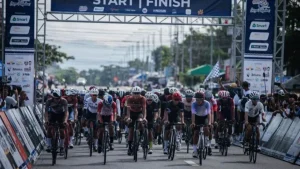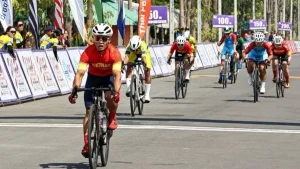
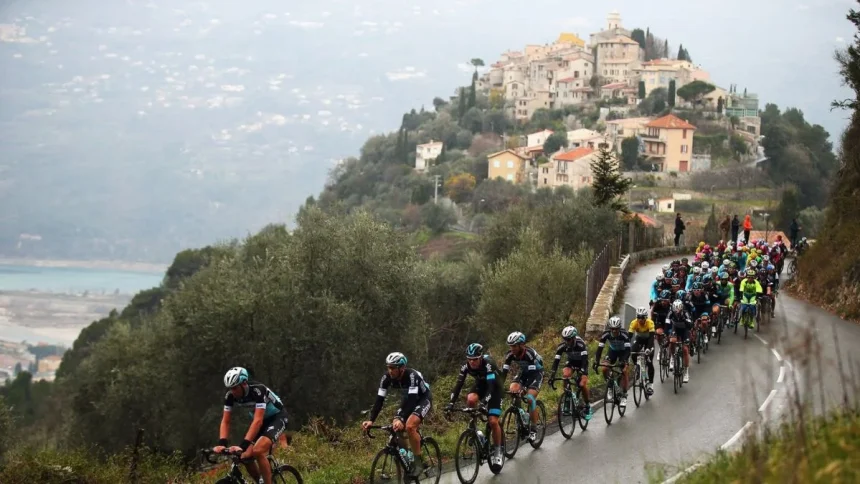
Winter may still grip much of Europe, but the unveiling of the Paris-Nice 2026 route is the surest reminder that spring is on the horizon. Announced on December 17, the course for the 84th edition of the “Race to the Sun” promises eight days of varied, demanding racing, blending tradition with thoughtful innovation. From Achères, northwest of Paris, to a reworked finale in Nice, the organisers have designed a route that rewards versatility, teamwork, and aggressive racing.
Covering 1,245 kilometres and packing in 16,460 metres of climbing, Paris-Nice 2026 cycling race is neither a pure climbers’ race nor a sprinters’ playground. Instead, it sits firmly in its classic role as a season-defining test: a proving ground for general classification contenders, a chance for teams to sharpen their collective edge, and an early battleground for punchy riders with an eye for opportunistic victories.

A Nervy Opening in the Yvelines
The race begins in Achères, a debut start town that continues Paris-Nice’s long relationship with the Yvelines département. Stage 1 immediately sets the tone. At 171.2km and nearly 2,000 metres of elevation gain, it is no ceremonial roll-out. Inspired by the historic Polymultipliée de Chanteloup, the stage finishes with two laps of a circuit in Carrières-sous-Poissy, each featuring the steep Côte de Chanteloup-les-Vignes (1.1km at 8.3%).
With the final ascent crested just 11km from the line and little time to reorganise, this is a stage designed for puncheurs and Classics specialists. Heavy sprinters risk being distanced early in the race, while the general classification could already show fractures before the race has truly settled.
Stage 2 offers brief respite. The 187km journey to Montargis is flat on paper, but the exposed plains of the Gâtinais are notorious for crosswinds. If the weather plays its part, what looks like the lone pure sprint opportunity of the week could easily turn into a chaotic, echelon-filled fight for position.

Teamwork Takes Centre Stage
Stage 3 brings one of the defining features of modern Paris-Nice: a 23.5km team time trial between Cosne-Cours-sur-Loire and Pouilly-sur-Loire. Now a fixture for the fourth consecutive year, the TTT is both a nod to tradition and a forward-looking exercise. With the 2026 Tour de France opening in Barcelona with a team time trial, this stage doubles as a high-stakes rehearsal.
The course itself is relatively gentle, with rolling terrain and just 240 metres of climbing, but exposure in the vineyards of the Loire region could amplify any wind. Unlike hillier TTTs that favour pure powerhouses, this route may encourage teams to arrive with more riders intact, adding a tactical dimension to how squads distribute effort. Time gained or lost here will echo through the rest of the week.
Into the Hills: The GC Battle Ignites
The race truly comes alive in the middle block. Stage 4, finishing atop Uchon in the Morvan, marks the first serious GC showdown. With 2,520 metres of climbing and a brutal finale featuring ramps well into double digits, the climb to the Signal d’Uchon is deceptive. Its average gradient hides savage variations that punish riders who misjudge their effort. Expect the first clear hierarchy among the overall contenders to emerge here.

If Stage 4 tests form, Stage 5 tests endurance. At 205km, it is the longest stage of the race and the one with the most elevation gain, totalling over 3,000 metres. Finishing in Colombier-le-Vieux, the stage features the race’s first first-category climb, including the brutally steep Côte de Saint-Jean-de-Muzols (2.2km at 11%). Coming less than 20km from the finish, it invites attacks from GC riders and stage hunters alike, with the uphill run-in ensuring that any gaps can be defended to the line.
Stage 6, from Barbentane to Apt, keeps the pressure on. With 2,100 metres of climbing and the ever-present threat of the Mistral wind, it is another day where positioning, timing, and bravery matter as much as raw climbing ability. The final ascent of the Côte de Saignon, just 4.5km from the finish, is tailor-made for late ambushes.
The High Point and a Reimagined Finale
As ever, Paris–Nice saves its most iconic moments for the closing weekend. Stage 7 is the queen stage, finishing at the ski resort of Auron. At just 138.7km, it is the shortest road stage, but with 2,580 metres of climbing and a summit finish averaging over 7%, it offers the pure climbers their best chance to make decisive gains. The long drag before the official start of the climb adds another layer of fatigue, ensuring that only the strongest can shine on the final slopes.
The race concludes with a reworked final stage in Nice, adapted due to municipal elections. While the start-and-finish city remains the same, the route explores different terrain, dropping some familiar climbs in favour of new challenges. The Col de la Porte, Côte de Châteauneuf-Villevieille, and the narrow, irregular Côte du Linguador form a demanding sequence that keeps the outcome uncertain deep into the final day. The finish at the Allianz Riviera stadium replaces the traditional Promenade des Anglais, but the spirit of the Nice finale-aggressive, technical, and unpredictable-remains intact.
A Route That Makes Sense
Paris-Nice 2026 looks thoughtfully balanced. Sprinters get their chance, but only if they survive the opening day. Puncheurs are spoiled with repeated opportunities. Climbers have a true summit finish and a final weekend worthy of the race’s reputation. And teams are placed firmly at the heart of the action thanks to a meaningful team time trial.
With defending champion Matteo Jorgenson set to pass on the yellow jersey and contenders like Simon Yates, João Almeida, Juan Ayuso, and a strong French cohort lining up, the route offers no hiding place. This is Paris–Nice as it should be: a race that rewards ambition, punishes weakness, and signals-loudly-that the European season has truly begun.
Also Read: Giro d’Italia 2026 Route Revealed: A Cross-Continental Epic Forged In Bulgaria And Finished In Rome
Paris-Nice 2026: Key Details
Dates: Sunday 8 March – Sunday 15 March 2026
Distance: 1,245 km
Elevation gain: 16,460 m
Stages: 8
Climbs: 27 classified (5 first-category)
Key features: Team time trial, summit finish at Auron, redesigned final stage in Nice
Start: Achères (Yvelines)
Finish: Nice (Allianz Riviera stadium)