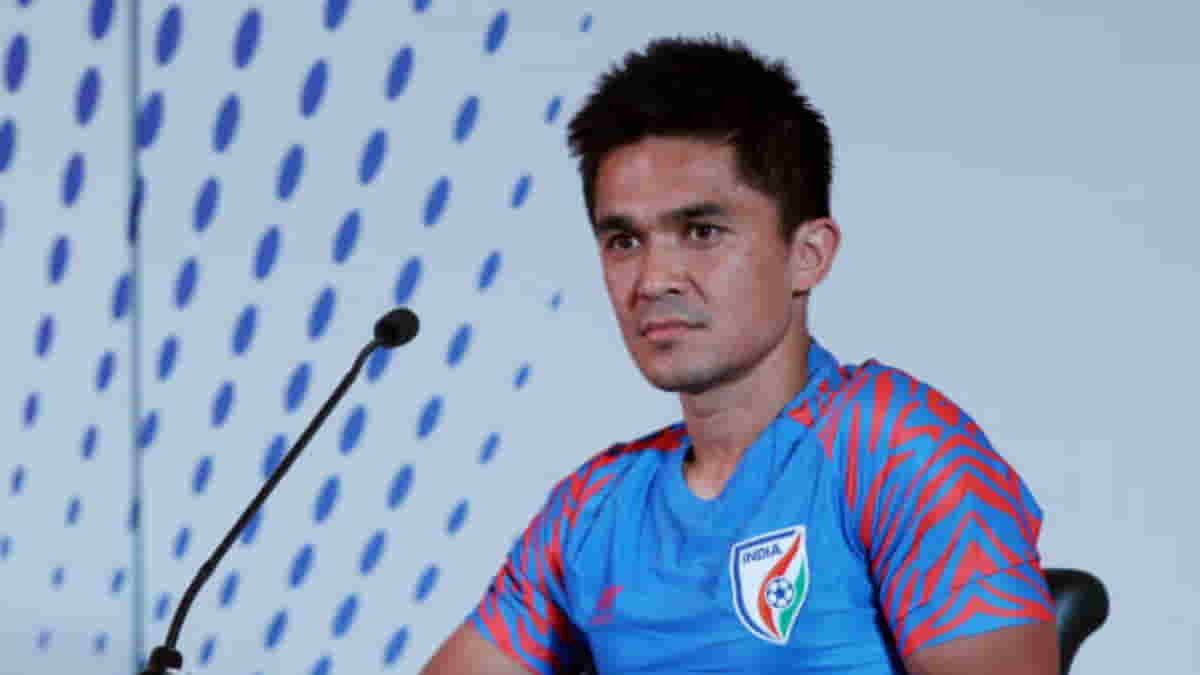
After defeating Kuwait on penalties, the Indian football team won its ninth South Asian Football Federation Championship (SAFF) championship. Sunil Chhetri, the captain of the Indian team, stood at the epicentre of the victory. For almost two decades, he has devoted his time to Indian football, inspiring a whole generation of players. Gautam Bhattacharyya, a sports writer, chronicles the player’s illustrious career.
Does their nation actually play football? is a common question that the diverse group of Indian football writers who travel to cover the Fifa World Cup encounter.
There is no surprise in the element of surprise. India hasn’t been able to shake the reputation that it is a cricket-obsessed country, despite the fact that it is known as a significant market for football tourism.
But Sunil Chhetri, the veteran Indian captain, stands out in this situation.
The 38-year-old goal machine, who helped his nation win the SAFF Championship and a modest Intercontinental Cup over the past three weeks, is currently the third-highest active footballer in terms of goals scored for an international team.

The top two scorers are Cristiano Ronaldo (123 goals from 200 appearances) and Lionel Messi (103 from 175). He has 93 goals in 142 games.
In terms of all-time rankings, Chhetri is fourth, trailing only Iranian legend Ali Daei, who has 109 goals across 148 games.
His story is made even more remarkable by the fact that the list of the top 10 footballers of all time is filled with legends from nations with a strong football history, including Ferenc Puskas of Hungary in sixth place with 84 goals and Robert Lewandowski of Poland in eighth place with 79 goals.
Read More
Compare that to the reputation of the nation Chhetri is from in terms of football. India’s last podium finish in a major competition was a bronze medal at the Asian Games in 1970, more than 50 years ago, and for as long as anyone can remember, their Fifa ranking has been somewhere around the 100-mark.
The national team, known as the Blue Tigers, did well for themselves by qualifying for two consecutive Asian Cup finals, but an Asian qualifying spot for the World Cup has remained a pipe dream.
Chhetri thrives in this environment and does so with a great deal of pride in his jersey.
His accomplishments have not gone unnoticed entirely, as Fifa last year produced a documentary about him called Captain Fantastic, which is accessible on the Fifa+ channel.
Every discussion with Chhetri ends up being about his competition for goals with Ronaldo and Messi, the game’s two superhumans.
To put things in perspective, Chhetri quotes Bob Houghton, a reputable British coach with whom he started his career while wearing Indian colours: “You cannot have the skills of Ronaldo or score goals like him, but nobody can stop you from working hard as him.”

Those are admirable words, but how does he continue to score goals at an impressive rate for a nation whose primary participation is in smaller competitions like the SAFF Championship, Intercontinental Cup, Asian Cup qualifiers, Asian Cup finals, and friendlies?
Since Chhetri’s entry into the scene, the Asian Games have remained off-limits, and the Nehru Cup, an invitational competition where he has nine goals, has also been abandoned.
Nearly 25% of his goals so far (24 total) have come from the SAFF Championship, which India won against Kuwait in Bengaluru on Tuesday following a shootout.
18 of these were scored in friendlies, 13 in the Intercontinental Cup, 9 in each of the Nehru Cup and Fifa World Cup qualifiers, and the remaining two in AFC competitions and the King’s Cup.
He has so far scored four hat-tricks, one of which came at SAFF against Pakistan. Yes, there might be the occasional snicker at the calibre of some of the opposition, but international football is a serious business.
Chhetri deserves a lot of credit for continuing to be the Blue Tigers’ go-to goal scorer after all these years and for maintaining his desire to do so. The SAFF Championship, which just ended, is evidence of that.
He scored six goals overall, including a hat-trick against Pakistan in their opening match, a strike rate that demonstrates incredible focus and consistency. But it also begs the question, “Who comes after Chhetri?”
It should come as no surprise that Chhetri’s success is largely due to his perseverance in international football and his strong work ethic.
Take the 2022–23 season as an example; it was his 18th year competing internationally and 21st year competing in clubs. Chhetri received his first international call-up in June of 2005, the same year as Messi and two years after the legendary Ronaldo.
Last year, during India’s Asian Cup qualifying matches in Kolkata, Chhetri and I had an open discussion about what motivates him. He said: “In the end, it’s all about making the little sacrifices,”
“It all depends on what I eat and how much sleep I get. For the kind of good life I have by God’s grace, choosing broccoli over biryani is not a big deal because I know I will have time for such indulgence once the game is over. There were several players who began playing around the same time as me and were on par with me or even better. But they were unable to keep up with the game’s physical demands, he said.
However, his years of experience at the club and international levels have enabled him to better understand his body and implement subtle tactical adjustments to extend his career.
The talismanic Chhetri was no longer a lock to start for Bengaluru FC in the most recent Indian Super League (ISL), and instead, he was more frequently used as a super sub.
This helped him stay energised for the demands of his country’s service. He no longer operated at the same rate, preferring instead to linger nearby before bursting into crucial, brief bursts of speed to reach the ball when it mattered the most.
Chhetri said that it was “evidence of the progress we have made and a big step forward” when asked about India’s chances at the Asian Cup in Doha in January, where they have been drawn with World Cup regulars Australia, Uzbekistan, and Syria. In the context of where we want to be, it is also a modest step. Top Asian teams like Japan, Iran, and Saudi Arabia always want to play against better and more highly-ranked opposition. That is how you get better. We will compete against higher-ranked teams at the Asian Cup. At that point, you can assess your development and how much your team has advanced.
In September, the qualifying rounds will start for the 2026 Fifa World Cup, which will feature a larger field of 48 teams.
Chhetri will undoubtedly be a part of this campaign as well, though the time to walk into the golden sunset is undoubtedly not far off. Chhetri recently received a one-year contract extension with his club and plans to continue as long as he is enjoying the game.
But as of right now, nobody, not even the team’s Croatian coach Igor Stimac, knows who will replace Chhetri.
The fans don’t either.
Also Read: Step-by-Step Guide to Launching Your Football Career: From Passion to Professional Opportunities
“Get more sports news, cricket news, and football updates, log on to sportsdigest.in. Follow us on Facebook or Twitter and Subscribe to our YouTube Channel.”