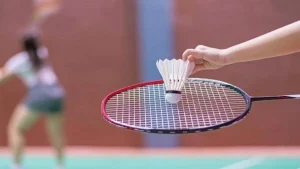

Badminton is considered to be one of the fastest racquet sports if not the fastest. Even though there are some similarities between Badminton and Tennis, the rules are distinct enough that they should be learned before playing your first game. Points are scored when a player successfully lands the shuttlecock inside his opponent’s half. The shuttlecock should reach the opponent’s play area by going over the top of the net. Here is a look at the rules of badminton.
How to win a game of Badminton?
Badminton like other racquet sports (Tennis and Table Tennis) is a sport played by either singles or doubles. A point is won if you or your team can land the shuttlecock inside the opponent’s half successfully and they cannot return the shuttlecock within the rules.
- A player/team must score 21 points to win a game. The winning margin needs to be at least two points. If a player or team is winning by 21-20 then the game will carry on until one of the players/teams reaches a winning margin of two points. If the game gets to 29-all then a sudden death point is played and whoever reaches 30 points wins the game.
- A match consists of three games. Whichever player/team wins two games first wins the match. If at the end of two games, the score stands 1-1 then whoever wins the third game wins the match.
Badminton court: Details
The badminton court is 20 feet (6.1 m) in width by 44 feet (13.4 m) in length. When playing singles, you play on the portion of the court that is just 17 feet (5.2 m) broad and 44 feet (13.4 m) long. Halfway across the court, at 20 feet (6.1 meters) (17 feet (5.2 meters) for singles), five feet (1.5 meters) above the floor, should be a three-quarter-inch mesh net. The extra 15 feet (1.5 m) on the left and right side of the court (the doubles sidelines) are acceptable serving and returning areas when playing doubles.
- There are right and left service courts on each side of the court. A team’s server must serve across the court that is diagonal from their starting court. Each time a point is scored, players are required to switch courts.
- On that side of the court, you can serve in singles to the back singles line and the opponent’s diagonal service box, but not to the broader doubles sideline.
- Serving in doubles is permitted to the diagonal service box of the opposing team, including the doubles sideline, but not to the singles long service line.
- As a result, the receiving court is wider and shorter for doubles serve than it is for singles service.
- When the shuttlecock is effectively served, the entire court of either team is open for attack. Simply keep the shuttlecock inside the doubles or singles court’s boundaries.
- Once a player makes a mistake, other players can score points. A point will be awarded to the server if they make the opponent commit an error. The recipient will get the point and take over as the new server for the following play if the recipient triggers a malfunction on the server (so the server can’t play it).
Basics of Badminton
Beyond the court details and the scoring guidelines, the following information is important to know before your badminton match:
- To determine which team will serve first and which side they will play on, toss a coin or have another competition.
- A badminton game begins with a serve from the right half of the court to the court diagonally across from it. For the remainder of the game, serve from the right if you have an even number of points and from the left if you have an odd number of points.
- If the serving side makes a mistake, the serve goes to the receiving side, who scores a point. The serving team switches from one service court to the next and continues to serve if it serves and the receiving side makes a mistake. Every time a serve is made, a point is scored.
- Each team in doubles only has one “service.” Therefore, the shuttle passes to a player on the opposing team if a player serving for one team faults, and so forth.
- The serving team does not change sides when a receiving team wins a point and receives the serve; instead, they serve from where they are standing. The players switch places from right to left if they score the first service point.
- The winning team gets to serve at the beginning of the following game after the opponents switch ends of the court following each game.
How do you get a fault?
A team or player may receive a fault for a number of different reasons.
Read More

- The shuttlecock must be hit to a point above or at the server’s waist when it is served; otherwise, it is incorrect. A fault may be assessed if any part of the racket at the instant of impact was not higher than any component of the serving player’s hand.
- if the serving team is unable to serve the ball over the net. In badminton, a player can only strike the shuttlecock once before it is deemed fair. You only receive one attempt at each serve in badminton. The sole exception to this rule is if your team receives a let, which occurs when the shuttlecock strikes the net and tips over into the court of the opposition. You will then have another chance.
- If at any time throughout the game, you hit the shuttlecock into or beneath the net.
- you get hit by the shuttlecock.
- if the ball is hit out of bounds, or if it is passed around or under the net to the opposing player. The dropping of shuttlecocks onto the line is considered fair play.
- A fault is compounded if you extend past the longest service line or strike the shuttlecock on the ground on your side of the court.
- if the shuttlecock is not served to the appropriate opposing court by the server.
- Any player who makes an effort to (successfully or unsuccessfully) hinder their opponent in any way incurs a fault.
- Any player’s foot must be entirely within the service court for play to begin; otherwise, a fault will be called.
- A player commits errors if they are able to touch the badminton net with any part of their body, their clothing, or any other item of equipment.
How to strike a shuttlecock?
A typical badminton racket measures 26 inches (66.0 cm) in length and weighs between 4.5 and 5.5 ounces. You’ll need to exert enough force to effectively strike the shuttlecock with this light racket as most of them are constructed of metal and nylon. Like in tennis, the forehand and backhand are the two main strokes, and to efficiently hit the shuttle, you’ll need a light, swift wrist.
- It all depends on your footwork. Position yourself such that you can easily hit the shuttle without having to stretch too much by seeing it and taking a few short steps in that direction.
- To hit the shuttle efficiently, you must practice your backswing, forward swing and hit, and follow through. The circular core of the shuttle, not its feathers, should be struck.
- Make your clear shot perfect. The main objective of this stroke, which is used frequently, is to knock the shuttle away from the net so that you have more time to position yourself for your subsequent shot.
- Get better at the drop shot. Effectively hitting this shot requires hitting a slow, gentle stroke that causes the shuttle to land just beyond the net, making it difficult for your opponent to reach, regardless of how quickly he runs.
- Smash the spacecraft. You may hit a shuttle that is higher than the height of the net with this strong shot. To hit the shuttle forcefully, diagonally down, as if you were smashing it over a fence, you must raise your racket behind your back as if you were about to scratch it. You must then anticipate the shuttle coming your way.
- Control the shuttle. In order to make it difficult for your opponent to anticipate or return your shot, choose a forehand or backhand shot that causes the shuttle to go parallel to the ground and just barely cross over the net.
- Realize that servers need to be able to tell when an opponent appears prepared to receive a stroke. When the opponent doesn’t appear ready to receive, the server shall not serve.
- Until the server hands the ball to their opponent, both players must be standing inside the boundaries of the court with both feet firmly planted on the ground. Players are not permitted to stand on any of the lines painted on the ground, as these are regarded as being outside the service court’s perimeter.