
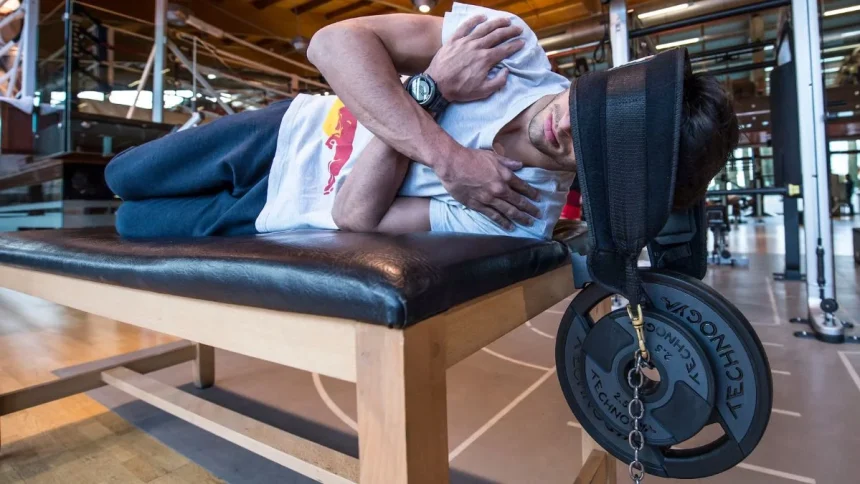
Ever watched an F1 race and wondered how F1 drivers keep their heads steady while whipping around corners at insane speeds? Spoiler alert: it’s not magic, it’s brutal neck training with special gear that turns their necks into steel cables. In Formula 1, where cars pull up to 6G forces, a driver’s helmeted head can feel like 30-40 kilos of dead weight trying to snap off.
That’s why elite drivers like Max Verstappen and Lando Norris grind with custom harnesses and machines, building the strength to endure a full Grand Prix without blacking out or losing control.
Why F1 Drivers Train With Special Neck Gear?
Picture this: you’re strapped into a cockpit, hitting 300 km/h, and slamming through high-speed turns. The g-forces yank your head side-to-side, forward-back, like a ragdoll in a blender. Without a rock-solid neck, vision blurs, reaction times tank, and crashes become way too real.
Neck muscles, think sternocleidomastoid, traps, and deep stabilisers, must resist up to five times your head’s normal weight just to keep eyes on the apex. Special gear mimics these forces safely, preventing injuries that could bench a F1 driver mid-season.
Enter the stars of neck training: the GS Harness and similar beasts. This padded leather headgear, loved by McLaren and Red Bull stars, uses straps, shock cords, and load cells to apply even resistance in all directions. Trainers pull until your head budges, just a fraction, while data tracks your max strength and endurance.
Read More

Safety first: it detaches instantly if forces go haywire, no vectoring into bad spots. Then there’s Technogym’s F1 machine, a cockpit simulator vibrating with elastic cables hooked to your helmet, cranking out centrifugal stress on neck, arms, and core.
Science-Backed Training
Training isn’t random chaos; it’s science-backed progression. Start with isometrics: press your head against bands or walls for 10-20 seconds per side, front-back-left-right. Graduate to dynamic rotations with harnesses, holding 30+ seconds as resistance climbs. Pros layer in neck bridges, flexion lifts, and core work like planks, because a weak midsection lets g-forces cheat your neck.
Sessions hit 3-4 times weekly, tailored via data to match track demands, endurance for 60-lap races, and explosive power for qualifying laps. F1 isn’t just cars, it’s human engineering at its rawest. Stay tuned, because as seasons heat up, these necks decide champions.
Read More

Also read: 2026 Formula 1 Drivers: A Complete List