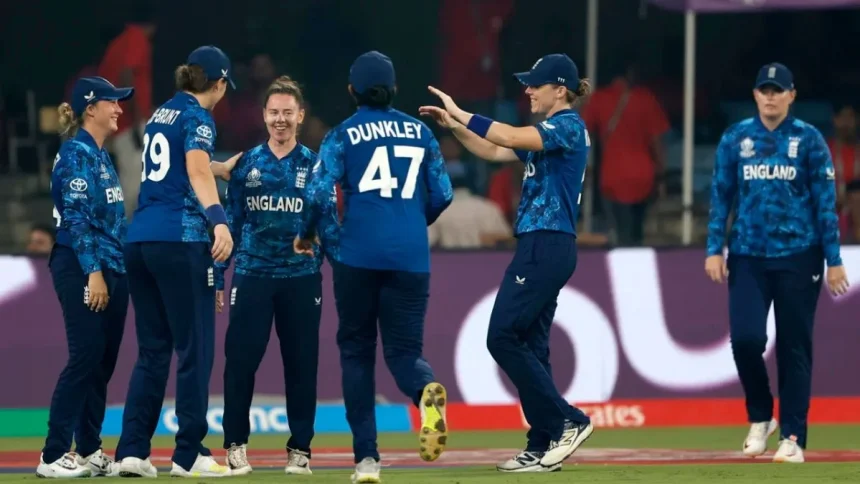
In a nail-biting match at the current World Cup, ENG vs IND witnessed England defeated India by 4 runs, entering the semifinals. India’s chase in the last few overs collapsed despite Deepti Sharma’s commendable all-round effort (4/51 & 50 runs). England, with this win, became the third team to seal their place in the semifinals of the tournament, while India had to endure their third successive defeat.
India’s Solid Beginning Crashes in Run-Chase
India were well on their way to winning the ENG vs IND World Cup match, as Smriti Mandhana and Harmanpreet Kaur shared a good partnership. Mandhana’s 88 runs, along with Harmanpreet’s 70, took India’s chase by the scruff of its neck.
The 125-run partnership between the two was the turning point ever since Mandhana was dismissed for 87, just 12 runs short of a well-deserved century. India was then left with a target of 55 runs from 53 balls, but found it difficult to score boundaries. That came to be a crucial phase within the game.
Although Pratika Rawal departed early, the Indian middle order, headed by Deepti Sharma, kept the chase alive. Deepti scored a half-century off 57 balls to contribute valuable runs, but until the pressure increased, India’s batting line up collapsed in the final few overs, scoring just six boundaries in the last 10 overs. The team lacked any acceleration that put them in a position of ultimate demise.
Mandhana and Harmanpreet’s Key Contributions
Uncharacteristically for Smriti Mandhana, she was extremely cautious in this game against ENG vs IND. Ordinarily, Mandhana bats with significant power and aggressive strokes. Mandhana only lasted 94 balls to score her 88 runs, which included 5 boundaries.

Harmanpreet Kaur, on the other hand, played a more level-headed innings, taking into consideration the field placements so that she could get her half-century. But she also couldn’t take the chase to the end, as she got out in the middle overs, and Deepti Sharma followed soon after getting caught in the deep off Sophie Ecclestone.
England’s Solid Start and Key Performances
Earlier in the game, England had registered a fighting total of 288/8, thanks to a magnificent 109 by Heather Knight. Knight’s fiery third ODI century arrived at a critical juncture, with England having lost early wickets. Tammy Beaumont (25) and Amy Jones (56) had set the stage with a spirited 73-run opening partnership, though India’s bowlers were trying hard to stem the flow.
Deepti Sharma, who previously had claimed two wickets in succession, gave India a welcome breakthrough when she removed Beaumont. Aggressive stroke play from Amy Jones, though, ensured runs kept coming for England.
Read More
Following the fall of both openers, Heather Knight and Nat Sciver-Brunt stayed at the crease long enough to bring up a 113-run third-wicket partnership, with Sciver-Brunt contributing a solid 39 runs.
Knight persisted to dominate, even when her partner fell. She took her century with an advantage that sprinted to the boundary, clinching England’s hold. But momentum changed once Knight got run out while trying a quick double, and the innings slowed.
Deepti Sharma’s All-Round Effort for India
Deepti Sharma’s performance with both bat and ball was a highlight of India’s resurgence in the game. Bowling, Deepti was magnificent, taking 4 wickets for 51 runs, including the important wicket of England’s most valuable batter, Deepti.
Her scoring 50 runs in the chase of the target kept India in the game, however it was not meant to be, with her efforts in vain by the Indian team not being able to chase down the target and losing the match by 4 runs.
England’s Dominance in Clutch Situations
The English bowlers, especially Nat Sciver-Brunt, really put a halt into India’s chase. Sciver-Brunt was able to pick up 2 wickets for 47 runs, which put pressure on the partnerships and slowed India’s run rate. Linsey Smith also bowled well, grabbing 1 wicket for 40 runs.
India’s lower-middle order, which comprised Amanjot Kaur and Sneh Rana, attempted to push the pace, but England’s bowlers remained tight, and the last wickets came in a hurry.
Read More

India’s Choice to Go Short on Batters Turns Expensive
One of the critical choices in this IND vs ENG match was India opting to send a batter short by replacing Rodrigues with Renuka Thakur. This batting lineup change by India proved ineffective in the end as anticipated. The lack of Rodrigues in the middle order caused India to labor towards the last overs since their lower order simply failed to collect the necessary runs during the death overs.
ENG vs IND: The Last Moments and England’s Triumph
Since England’s score looked below-par for a flat track with a quick outfield, India’s chase had looked within reach initially. But with 42 runs being scored off the last six overs and India losing five wickets during that time, pressure took its toll. Even some late fireworks from Sneh Rana and Amanjot Kaur couldn’t help them past the required rate, giving England a thriller 4-run win.
Brief Scores of the ENG vs IND World Cup Match:
England: 288/8 in 50 overs (Heather Knight 109, Amy Jones 56; Deepti Sharma 4-51, Shree Charani 2-68)
India: 284/6 in 50 overs (Smriti Mandhana 88, Harmanpreet Kaur 70; Nat Sciver-Brunt 2-47, Linsey Smith 1-40)
Result: England won by 4 runs
ALSO READ: IND vs AUS: Marsh Takes Australia To Comfortable Win In Rain-Halted ODI