

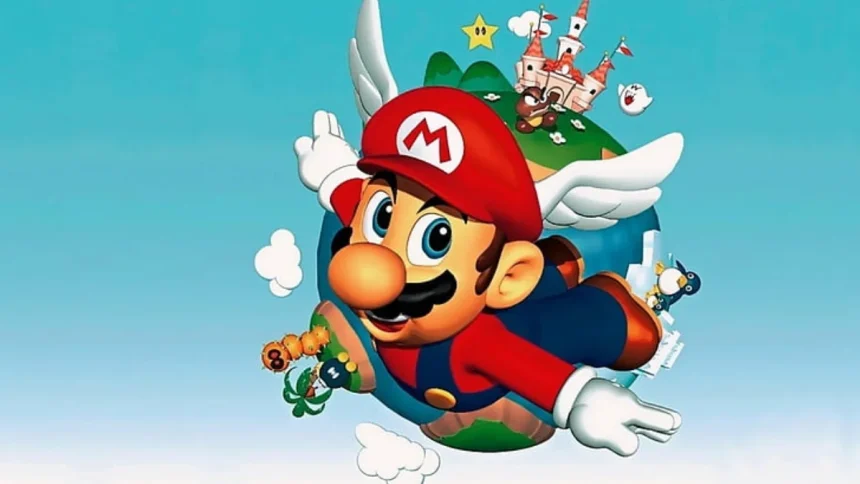
Released in 1996 for the Nintendo 64, Super Mario 64 changed gaming forever by showing how 3D worlds could truly work. Its smooth movement, long jumps, wall kicks, and momentum-based controls still feel precise nearly 30 years later.
Players explore Peach’s Castle and collect 120 Power Stars through open-ended missions. Though its graphics now look blocky, its freedom, challenge, and creativity remain timeless. It sold over 11.9 million copies worldwide and shaped future 3D games.
Super Mario 64: Freedom, Precision, and Lasting Greatness
Released in 1996 on the Nintendo 64, Super Mario 64 became a landmark in gaming history because of its precise and responsive controls. Mario can run, long jump, backflip, dive, wall kick, and combine moves smoothly, creating deep skill-based gameplay that still feels modern.
It’s 15 main worlds and Peach’s Castle hub reward curiosity, letting players explore large spaces instead of following one fixed path. Progress depends on collecting Power Stars, with 70 needed to finish the main story and 120 for full completion. This design gives players freedom to choose their journey. More than 11.9 million copies were sold, proving its timeless influence and enduring brilliance.
Super Mario 64: Timeless Design and Endless Legacy
Released in 1996 for the Nintendo 64, Super Mario 64 proves that great gameplay can outlive old graphics. Its blocky visuals reflect early 3D technology, yet the main experience of exploring worlds, defeating enemies, and mastering platform jumps still feels strong today. Players can collect 120 Power Stars across 15 main courses,

showing how much content the game offered for its era. Its influence shaped many later 3D platformers, including games built around free movement and open levels. The legacy remains active through speedrunning, where players still chase world records, and through fan mods that create new stages. With over 11.9 million copies sold, its greatness continues across generations.
Super Mario 64: Greatness Touched by the Passage of Time
Released in 1996, Super Mario 64 remains historic, yet some parts clearly show its age. Its camera system, once revolutionary for early 3D gaming, can become awkward in narrow rooms or near walls, where angles sometimes block clear vision. The graphics, built with low-polygon 64-bit technology,
Now appear simple compared with modern games, though many players still value their retro charm. Certain controls, especially underwater swimming and precise platforming missions, may feel less smooth than today’s standards. Even with these flaws, the game still offers 120 Power Stars across 15 main courses and helped define 3D platform design. Time exposed weaknesses, but greatness still survives within it.

ALSO READ: Top 10 Indian Hockey Players with the Most Olympic Medals