
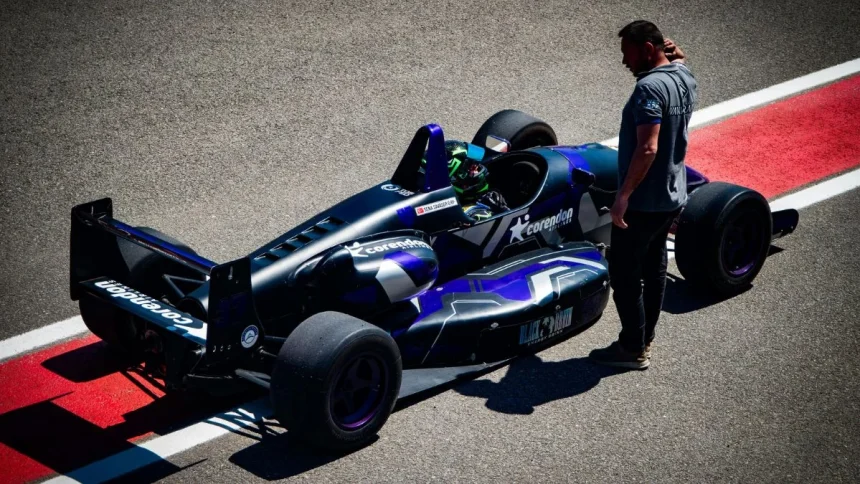
F1 is the fastest and most expensive form of car racing in the world. It is the highest level you can reach in motorsport. The World Championship began on May 13, 1950, at Silverstone in England, where Italian driver Nino Farina won the very first race driving an Alfa Romeo. He went on to become the first-ever F1 World Champion that same year.
Today, F1 cars reach speeds above 370 km/h. Teams spend hundreds of millions of dollars every season just to find tiny improvements. A single point can decide championships. And when that much money, pride, and glory are involved, things can go very wrong very fast.
Over 75 years of racing, Formula 1 has seen cheating, deliberate crashes, stolen secrets, and decisions so unfair that millions of people are still arguing about them today.
Top 10 Biggest Controversies In F1 History
Here are the 10 biggest controversies in F1 history.
1. Villeneuve vs Pironi (1982)
Gilles Villeneuve and Didier Pironi were teammates at Ferrari. At the 1982 San Marino Grand Prix in Italy, they were running 1st and 2nd with the race already won. Ferrari told both drivers to slow down and hold their positions; there was no reason to keep racing each other. Villeneuve followed the order, but Pironi did not. On the final lap, Pironi overtook his own teammate and stole the win.
Read More
Villeneuve was devastated. He said he would never trust Pironi again. Two weeks later, at qualifying for the Belgian Grand Prix, Villeneuve crashed and was killed. He was 32 years old. Many believe he was pushing too hard, still furious, still trying to beat Pironi at any cost.
2. Senna Deliberately Crashes Into Prost (1990)
Ayrton Senna and Alain Prost had the greatest rivalry in F1 history. Going into the 1990 Japanese Grand Prix, Senna was leading Prost in the championship. He needed to finish ahead of Prost to win the title.
Before the race, Senna had complained to the FIA about where pole position was placed on the track; he felt it gave Prost an unfair advantage from second place. The FIA ignored him.
On the very first corner of the very first lap, Senna drove straight into Prost’s car. Both drivers were out of the race immediately. Because Prost scored no points, Senna won the championship.
Years later, Senna publicly admitted it was deliberate. He said that since the FIA had done nothing about a similar incident the year before, he had decided to take things into his own hands.
3. Adelaide 1994
The 1994 season was already F1’s darkest, with Ayrton Senna and Roland Ratzenberger both dying at Imola earlier that year. The title fight between Michael Schumacher and Damon Hill arrived at the final race in Adelaide, Australia, with Schumacher ahead by exactly one point. Hill needed to outscore Schumacher to become the World Champion.
On Lap 36, Schumacher clipped a wall and damaged his car. Hill saw the chance and dived inside him at the next corner. As Hill pulled alongside, Schumacher turned in. Both cars made contact.
Schumacher was out on the spot. Hill’s car made it to the pits, but the damage was too bad to continue. Because neither driver scored points, Schumacher won his first World Championship by that single point.
The FIA called it a racing incident and took no action. The Williams team, and Hill himself in later years, said they believed Schumacher steered into him deliberately.
Read More

4. Schumacher Drives Into His Title Rival (1997)
At the 1997 European Grand Prix in Jerez, Spain, Michael Schumacher and Jacques Villeneuve were separated by just one point in the championship going into the final race. Late in the race, Villeneuve tried to overtake Schumacher. As he came alongside, Schumacher turned his car sharply into him, seemingly trying to knock him out of the race and clinch the title. But this time, Schumacher’s own car took the worst of the contact and went into the gravel. Villeneuve’s car was damaged but kept going. He finished third and won the World Championship.
The FIA’s punishment was unprecedented. For the first and only time in F1 history, a driver had all of his points for an entire season stripped away. Schumacher’s whole 1997 championship score was erased from the records, and he was removed from the standings completely.
5. Austria 2002
Rubens Barrichello was leading the Austrian Grand Prix in 2002. He had driven a perfect race; the winning title was his. Then, with just a few corners left, his Ferrari team told him over the radio to slow down and let his teammate Michael Schumacher pass him. Team orders like this were actually banned in F1 at the time. Ferrari gave them anyway, in plain view of the whole world.
Barrichello moved aside, and Michael Schumacher won. Even though Schumacher looked uncomfortable on the podium, he swapped his winner’s trophy with Barrichello as a sort of apology. The crowd booed loudly. Ferrari was fined $1 million for breaking the rules, but got to keep the result.
6. The 2005 United States Grand Prix
Imagine buying a ticket to a concert and watching most of the performers walk off stage before playing a single note. That is what happened to 120,000 fans at Indianapolis in 2005.
Tyre supplier Michelin had discovered, after a dangerous blowout in practice that injured Ralf Schumacher, that their tyres could not safely handle one particular high-speed corner at full racing speed. They asked the FIA to either slow that corner down with a chicane or allow an extra tyre change during the race. The FIA said no.
So on race day, all 14 cars using Michelin tyres completed the formation lap, then drove straight into the pit lane and stopped. They refused to race.
Only six cars, all using Bridgestone tyres, actually competed. Schumacher won a race with almost no one in it, while tens of thousands of fans in the grandstands booed and some threw objects onto the track.
7. Spygate (2007)
In 2007, a Ferrari mechanic named Nigel Stepney secretly passed hundreds of pages of Ferrari’s confidential technical documents to Mike Coughlan, the chief designer at McLaren. These documents contained Ferrari’s car design secrets.
When Ferrari found out, the FIA launched an investigation. McLaren was found guilty of having Ferrari’s stolen documents. The punishment was historic: McLaren was stripped of all their Constructors’ Championship points for the entire 2007 season and fined $100 million.
That fine remains the largest ever handed to any team or individual in any sport in the world. McLaren’s drivers, Fernando Alonso and Lewis Hamilton, kept their personal points, but the team itself was effectively erased from the 2007 season.
Nigel Stepney was later convicted of criminal offences in Italy.
8. Crashgate (2008)
This is the most brazen act of cheating in F1 history. A team boss actually told his own driver to deliberately crash his car into a wall, at racing speed, in the middle of a Grand Prix, to fix the result.
At the 2008 Singapore Grand Prix, Renault’s Fernando Alonso had made an early pit stop that left him stuck far down the field with no realistic chance of winning. But team boss Flavio Briatore had a plan. On Lap 14, Fernando Alonso’s teammate, Nelson Piquet Jr., drove his car into the wall on purpose. The safety car came out. Other cars made pit stops. When the dust settled, Alonso was in the lead and went on to win the race.
The truth stayed hidden for over a year, until Piquet Jr. was dropped by Renault mid-2009 and told the FIA everything. Briatore received a lifetime ban from F1. Technical director Pat Symonds was also banned.
9. Liegate (2009)
Just two years after Spygate, McLaren was in trouble again. At the 2009 Australian Grand Prix, Lewis Hamilton gave incorrect information to race stewards during an enquiry.
During a safety car period, an incident occurred involving Jarno Trulli’s Toyota. Radio communications between Hamilton and his team later revealed that McLaren had actually told Hamilton to let Trulli past, but Hamilton initially told the stewards that this had not happened.
When the recordings were reviewed, it was clear that the information Lewis Hamilton had given was not true. He was stripped of his third-place finish. McLaren’s sporting director, Dave Ryan, who had been present during the stewards’ hearing, was fired by the team.
Lewis Hamilton publicly apologised and accepted full responsibility.
10. Abu Dhabi 2021
The most-watched F1 race in history. And the most controversial finish the sport has ever seen, made even more damaging by the fact that the FIA later confirmed the rules were broken. The result still stood.
Lewis Hamilton and Max Verstappen arrived at the final race of the 2021 season level on exactly 369.5 points each. Whoever finished higher would be the World Champion. For Lewis Hamilton, a win meant a record-breaking eighth title, and for Max Verstappen, a win meant his first-ever championship.
Lewis Hamilton led the race comfortably and looked set to win. Then, with five laps to go, a crash by Nicholas Latifi brought out the safety car. Max Verstappen immediately dived into the pits for the fastest, freshest tyres available.
Lewis Hamilton stayed out to protect his lead. Crucially, there were five slower lapped cars sitting between them on the track, which under normal safety car rules would have stayed there until the end, effectively protecting Lewis Hamilton.
Then, race director Michael Masi made a decision. He told only those five cars between Lewis Hamilton and Max Verstappen to move aside, not all the lapped cars, as the regulations required and then brought the safety car in immediately, without the mandatory extra lap the rulebook called for.
The result was a one-lap dash to the finish, with Max Verstappen on fresh soft tyres right behind Hamilton on hard tyres that had 35 laps on them.
Max Verstappen drove around Hamilton on the final lap and won. He was the World Champion. Mercedes protested immediately, but it was rejected.
In March 2022, the FIA published an official report confirming that Masi had made ‘human error’; the regulations had not been correctly followed. Masi was removed from his role as race director, but the result of the race and the championship was not changed.