
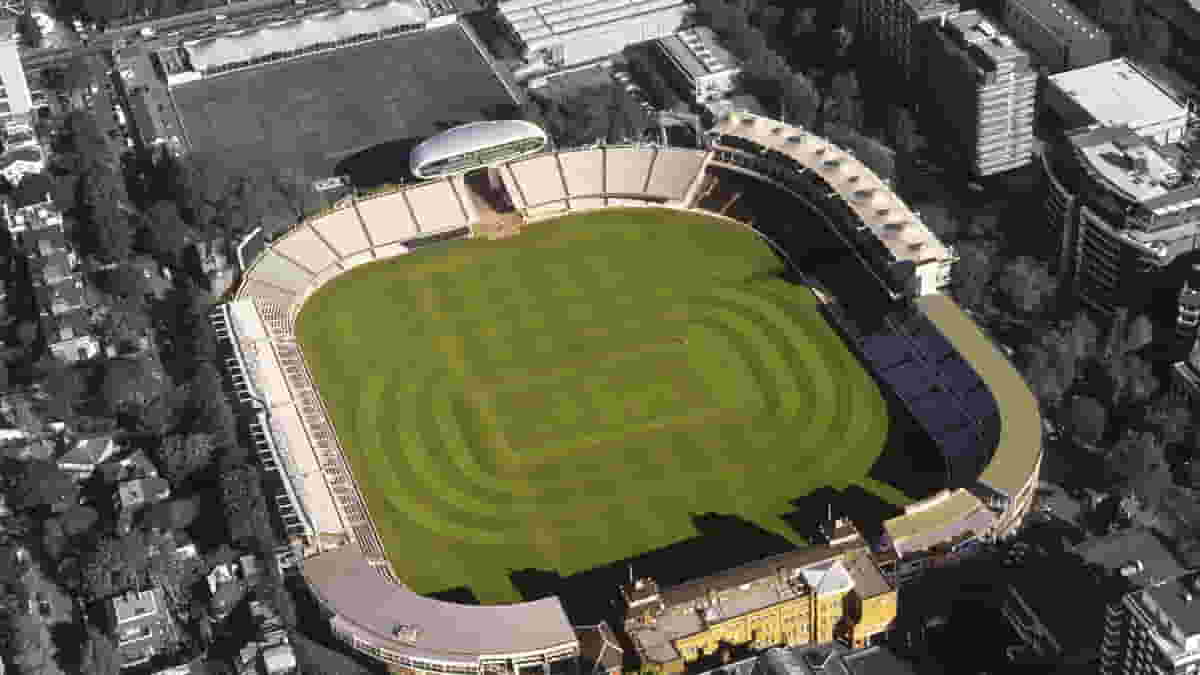
A great reason to spend an entire afternoon outside with a nice cool beer and excellent company is cricket. Additionally, the location is a key aspect of the experience, as it is with other spectator sports. In this article, we will take a look at the world’s most famous, significant, and atmospheric cricket stadium that ensures cricket enthusiasts have a once-in-a-lifetime experience.
Lord’s Cricket Ground, London, United Kingdom
Lord’s is the most well-known cricket stadium in the world and is referred to as the “home of cricket.” It was constructed in 1814 and is named for Thomas Lord, who at the time owned Marylebone Cricket Club, the organization in charge of enforcing cricket’s rules. More than 100 Test matches have been played here, and many records have been broken. Graham Gooch has scored 2,015 Test runs at this venue, which is the most of any player. The world’s oldest sports museum is located in Lord’s, and it features a collection of artefacts, including a stuffed sparrow that was struck by Jahangir Khan’s tremendous bowl during a match in 1936 while it was in the air.
Lord’s Cricket Ground: History
Thomas Lord opened his first ground in May 1787 on the location of Dorset Square, on property leased from the Portman Estate, acting on behalf of White Conduit Club members and guaranteed against any losses by Colonel Charles Lennox and George Finch, 9th Earl of Winchilsea. The White Conduit relocated from Islington to Marylebone Cricket Club (MCC) shortly after leaving White Conduit Fields because they were dissatisfied with the quality of the playing surface.
White Conduit Fields was deemed to be too far from upscale Oxford Street and the West End, leading to the idea that a new stadium would provide its members with a greater sense of exclusivity. Middlesex faced Essex in the inaugural game at the new venue. Due to an increase in rent, Lord felt compelled to transfer in 1811 and removed his turf and re-laid it at his second field. This was short-lived due to the location being against patron preference and the ground being on the path chosen by Parliament for the Regent’s Canal.
Lord’s Cricket Ground: Stands
In the later part of the 20th century, many of the stands were rebuilt. The GrandStand, built by Nicholas Grimshaw, debuted in 1996 after the new Mound Stand, created by Michael Hopkins & Partners, opened in 1987. In 1999, the Media Centre was inserted between the Compton and Edrich Stands, across from the Pavilion. It was created by Future Systems and received the 1999 Stirling Prize from the Royal Institute of British Architects. The Compton Stand and Edrich Stand renovations were finished in 2021, adding 2,600 seats and increasing the stadium’s capacity to 31,100 spectators.
Read More

Lord’s Cricket Ground: Pavilion
The current pavilion at Lord’s was constructed in 1889–1890 and is the third pavilion to have stood on the grounds. It is the main surviving structure from the Victorian era. Since September 1982, it has been designated as a Grade II* listed structure. Brick was used in the construction of the pavilion, and it has elaborate terracotta faces, including terracotta gargoyles like “The Patriarch,” which is said to depict Lord Harris. The structure consists of two end towers with pyramidal roofs topped with elaborate wrought and cast iron lanterns, and a long, two-story middle portion with covered seating. The pavilion roof terrace, which offers views of the entire ground, extends the full length of the rear of the second level.
Lord’s Cricket Ground: Media Center
At a 1995 MCC committee meeting, the decision was made to construct the Media Centre. According to these proposals, the Warner Stand, which could hold 90 journalists, as well as the wooden shacks scattered over the field for commentators, would be replaced with a new, purpose-built structure. Following that, it was ratified by MCC members at a special general meeting held in December 1996. was created by the Czech architect Jan Kaplick-led Future Systems architectural firm, costing roughly £5 million, and was the first semi-monocoque skyscraper made entirely of aluminium. The building process started in January 1997, and it was finished in time for the 1999 World Cup. It was constructed in 32 parts and outfitted by the Falmouth-based Pendennis Shipyard and Centraalstaal of the Netherlands.
Lord’s Cricket Ground: MCC Museum and Library
The MCC Museum, the oldest athletic museum in the world and located at Lord’s, houses the most renowned collection of cricket memorabilia in existence, including The Ashes urn. Since 1864, MCC has been amassing artefacts; Sir Spencer Ponsonby-Fane, who later served as the club’s treasurer, started the collection. As they were initially on exhibit in the pavilion, only MCC members had access to the collection. After the Second World War, it was decided to move the collection and make it accessible to the public because it had outgrown its original location in the pavilion.
Read More

Also Read: Step-by-Step Guide to Become an International Cricket Umpire
“Get more sports news, cricket news, and football updates, log on to sportsdigest.in. Follow us on Facebook or Twitter and Subscribe to our YouTube Channel.”